
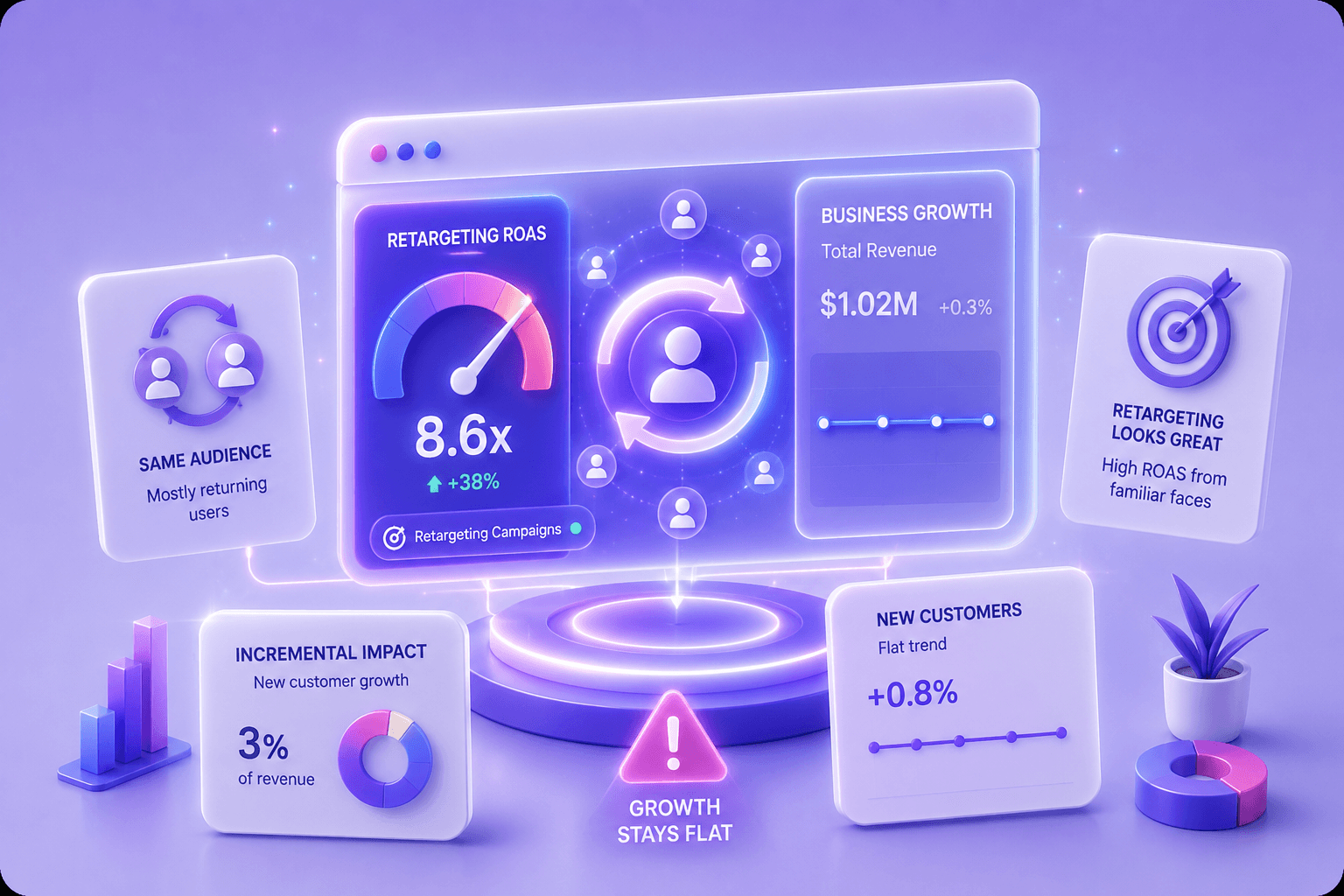
Why Your Retargeting ROAS Looks Great While Your Business Stays Flat
Your retargeting campaign has been running for 90 days. It reports 8x Return on Ad Spend (ROAS), the highest in your account. Total account conversions have not moved in three months. You pause retargeting for two weeks. Revenue does not drop. That is the incrementality problem. Retargeting campaigns report inflated ROAS because they reach audiences already planning to buy. The platform attributes the conversion to the ad that appeared closest to the purchase moment, regardless of whether that ad changed the decision. This post explains why retargeting ROAS is structurally overclaimed, what the typical gap between platform ROAS and true incremental ROAS looks like, and how to measure it correctly.
Quick Summary
Retargeting audiences (website visitors, cart abandoners) convert at a high base rate regardless of ad exposure; the platform attributes those organic conversions to the paid campaign.
The gap between platform-reported retargeting ROAS and true incremental ROAS is typically 4-6x. A campaign showing 8x platform ROAS often shows 1.5-2.5x incremental ROAS when a holdout group is measured.
Scaling retargeting past 10-15% of total ad budget typically does not grow total account conversions. It transfers attribution from organic channels to paid.
Meta's Incremental Attribution feature (generally available April 2025) runs a native 15% holdout to separate conversions the ad caused from conversions that would have happened regardless.
Capping retargeting and protecting prospecting spend keeps new customer revenue from eroding behind a platform ROAS number that looks healthy.
Retargeting Audiences Already Plan to Buy Before They See Your Ad
Retargeting targets people who have already visited your product page, added to cart, or viewed a specific SKU. Those behaviors are strong purchase-intent signals on their own.
A cart abandoner is already in a decision process. They may complete the purchase through a follow-up email, a direct site visit, or a branded search they planned to run, which is exactly why "how AI automates your marketing funnel " matters more than platform-reported retargeting ROAS alone.
Base conversion rate is the share of a retargeting audience that converts without any ad exposure. When a platform's attribution window credits an ad for every purchase made by someone who saw that ad within 7 days, it counts many conversions that would have happened through organic channels. The ad appeared near those conversions, not before them in the causal chain.
Because retargeting audiences carry high base conversion rates, even a campaign with near-zero incremental lift produces strong platform ROAS. The platform cannot distinguish between a conversion its ad caused and a conversion it merely sat next to.
Platform ROAS and Incremental ROAS Are Not Measuring the Same Thing
For prospecting campaigns, platform ROAS and incremental ROAS tend to move together. Cold audiences have low prior purchase intent, so most attributed conversions required the ad to happen. For retargeting, the two metrics diverge sharply.
Documented holdout studies show the typical gap is 4-6x. An analysis by seresa.io found 481 total attributed purchases in a retargeting campaign, but only 171 were incremental, a 64% overclaim rate.
Cometly's DTC holdout research found campaigns reporting 8x platform ROAS delivering true incremental ROAS closer to 2x. Industry practitioners estimate that 75% of retargeting conversions attributed by the platform would have occurred without the ad (attribuly.com, 2025).
Dimension | Retargeting | Prospecting |
|---|---|---|
Typical platform ROAS | 5-10x | 2-4x |
Typical incremental ROAS | 1.5-2.5x | 1.5-3.5x |
Base conversion rate | High (prior intent behavior) | Low (cold audience) |
Attribution window behavior | Captures mostly base conversions | Captures mostly ad-driven conversions |
Recommended budget share | 10-15% of total spend | 85-90% of total spend |
The key pattern: prospecting and retargeting often produce similar incremental ROAS, but retargeting's platform ROAS reads 2-4x higher. Teams allocating budget toward platform ROAS reduce prospecting, the channel generating new customer revenue, to fund a campaign that converts buyers already in the pipeline.
How Meta Incremental Attribution Exposes the Gap
Meta's Incremental Attribution setting (GA April 2025) provides a platform-native way to measure this without running a separate conversion lift study. The mechanism:
Meta withholds ads from a randomly selected 15% holdout group within the campaign's target audience.
It tracks conversions in both the exposed group and the holdout group over the campaign window.
It computes the difference in conversion rates between the two groups.
It reports only that difference, the conversions the ad caused, as the campaign's result.
When Incremental Attribution is active, retargeting campaigns consistently report lower numbers than standard attribution. That lower number is the accurate one. A set of 37 conversion lift studies run by Meta across 30 advertisers and 8 verticals (July-October 2024) found that campaigns optimized for incremental conversions delivered 46% more incremental results versus business as usual.
Incremental Attribution does not work with cost cap bid strategies and performs best on prospecting campaigns where measuring true lift matters more than defending a reported ROAS benchmark.
High Retargeting ROAS Is a Signal the Wrong Metric Is Driving Budget
Platform ROAS and incremental ROAS move in opposite directions as audience intent rises. A cart abandoner pool converts at a higher base rate than a 30-day site visitor pool.
The cart abandoner campaign reports higher platform ROAS. It also delivers lower incremental lift, because more of those conversions needed no ad to happen.
When budget follows platform ROAS, spend concentrates on the warmest audiences: the ones most likely to convert through email or direct regardless of the ad. The retargeting campaign collects credit from those organic channels. Prospecting budget shrinks.
The specific consequence: total account conversions plateau. Retargeting ROAS stays high. The metric signaling success is the metric causing the stagnation.
Correcting this requires platforms that treat incremental performance as the primary allocation signal rather than reported ROAS, the same shift at the core of modern AI ad optimization Maino.ai's Optimization AI applies this measurement logic to budget decisions across accounts. Maino.ai has optimized over $150 million in ad spend across 50+ global clients.
When Retargeting Budget Does Drive Genuine Lift
The argument above does not hold in every situation. Three conditions produce real incremental value from retargeting.
Short windows on high-urgency offers. A 1-3 day retargeting window on a flash sale, event ticket, or subscription renewal captures genuine lift. Urgency compresses the decision cycle enough that the organic fallback rate is meaningfully lower. This breaks when the same window is applied to evergreen products where urgency is manufactured rather than real.
High-ticket products with long consideration cycles. A retargeting audience of users who spent significant time on a product page but did not purchase may not convert organically within any reasonable window. The consideration cycle is long enough that an ad can re-enter the decision. This assumption fails when the holdout period is too short to observe the true base rate, producing a false positive for incremental lift.
Brands with limited organic reach. For brands with small email lists and minimal branded search volume, the base rate for retargeting audiences is lower than for established brands. Incremental lift is higher when there is no organic fallback. This reverses once the email list scales past a few thousand active subscribers receiving triggered cart-abandonment sequences.
Accounts that hold retargeting to a tight audience window, cap it at 10-15% of total spend, and protect prospecting budget find that total conversions hold or grow when retargeting shrinks. The explanation is not that retargeting was harmful. It was claiming credit for revenue that did not belong to it. Treating retargeting as a measurement problem rather than a campaign problem changes which lever actually moves total account results.
Frequently Asked Questions
Why does retargeting ROAS look so much higher than prospecting?
Retargeting audiences have already visited your site, viewed a product, or abandoned a cart. A large share would buy through email, direct navigation, or organic search without the ad. The attribution window credits the ad for those organic conversions. Prospecting faces cold audiences where most attributed conversions required the ad, so platform ROAS and incremental ROAS stay closer together.
What is incremental ROAS and how does it differ from platform ROAS?
Incremental ROAS measures only revenue the ad caused: conversions that would not have happened without ad exposure. It is calculated by comparing conversion rates between an exposed group and a holdout group that never saw the ad. Platform ROAS counts every attributed conversion within the window regardless of cause. For retargeting, holdout studies show a typical 4-6x gap between the two metrics.
How does Meta Incremental Attribution work?
Meta holds back 15% of the campaign audience from ad exposure, tracks that group's conversion rate, then compares it to the conversion rate of the exposed group. The campaign receives credit only for the difference. The setting is available in Ads Manager under Show More Options in campaign setup. It is not compatible with cost cap bid strategies.
When should you not run retargeting at scale?
Avoid scaling retargeting when your email list covers most of your retargeting audience (organic recall replaces paid recall at no cost), when a holdout test shows incremental ROAS below 1.0x, or when you are retargeting evergreen products with no real urgency. In all three cases, reducing retargeting budget and protecting prospecting typically maintains or grows total account conversions.
© Maino.ai | maino.a