
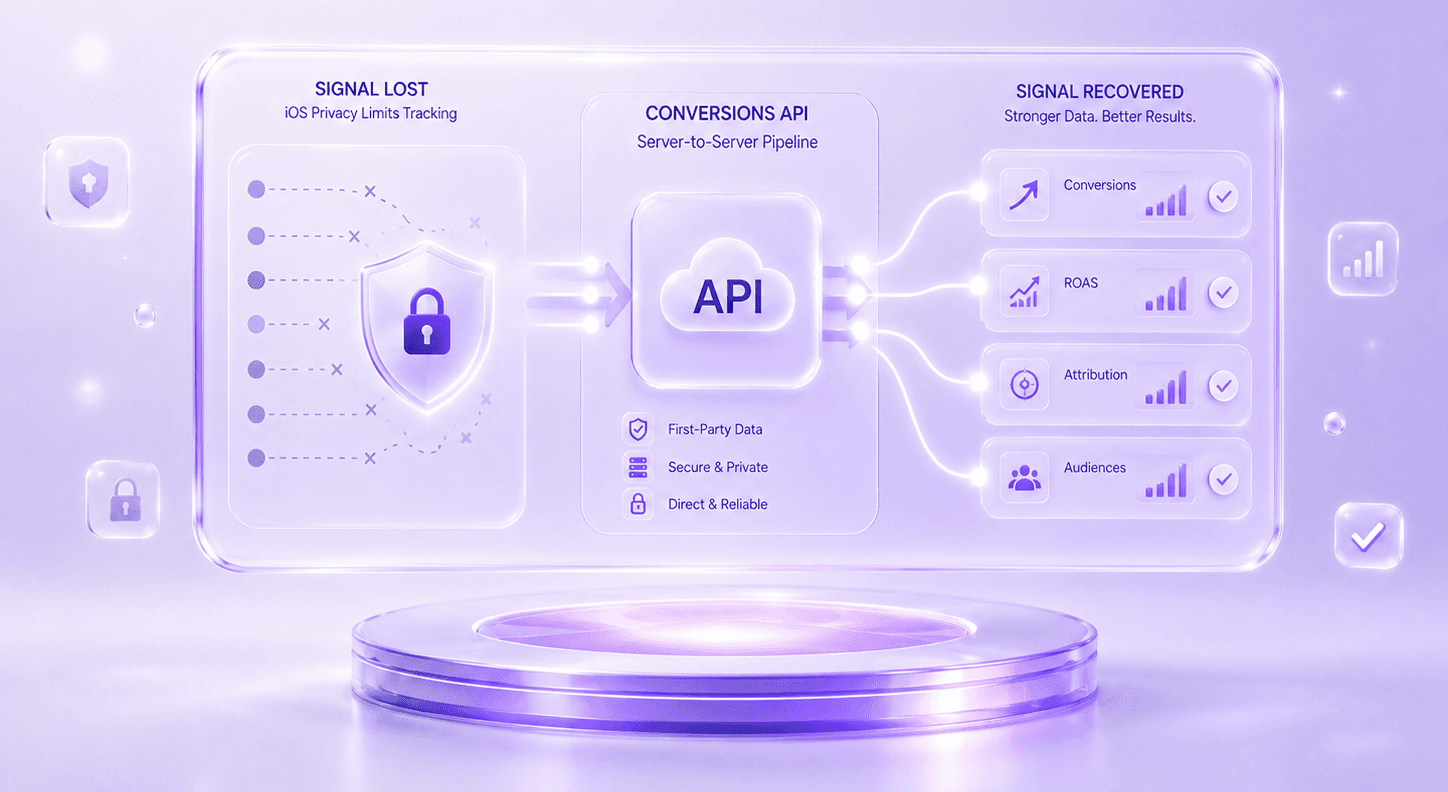
How the Conversions API Recovers Signal Lost to iOS Privacy
Quick Answer
The Conversions API recovers iOS signal loss by sending conversions from your server with hashed first-party data, which bypasses cookie and ATT limits. It raises Event Match Quality and deduplicates against the pixel through a shared event_id, so optimization trains on real conversions rather than modeled counts.
For years a browser pixel watched every conversion and reported it back to the ad platform. A user purchased, the pixel fired, and the event matched cleanly to a profile. Apple’s App Tracking Transparency (ATT) broke that arrangement in iOS 14.5. Across apps that showed the prompt, opt-in hovered near 25%, so roughly 75% of those iOS users blocked cross-app tracking. The pixel still fires, but it loses the identifiers that let the platform match events to people. Conversions API iOS signal loss is the gap that opens here. This post explains what the Conversions API recovers, how it deduplicates against the pixel, and where it still falls short.
Quick Summary
Browser pixels lose iOS conversions because ATT opt-outs strip the identifiers needed to match events to users.
The Conversions API sends conversion events from your server, bypassing browser and cookie restrictions.
Server-side events carry hashed customer data collected at checkout, which raises Event Match Quality above pixel-only levels.
A shared event_id deduplicates pixel and server events so the same purchase is not counted twice.
The Conversions API recovers match quality and optimization signal, but it does not reverse Apple’s privacy limits on opted-out users.
Why Browser Pixels Lost iOS Conversions
The pixel depends on the browser to observe an action and identifiers to attach it to a user. ATT removed Apple’s device identifier from that flow for opted-out users. Without it, the platform receives an event it cannot confidently match to a real account.
Browser storage limits compounded the problem. Safari caps cookie lifetimes, so the click identifier that links an ad to a sale often expires before the purchase happens. The event arrives with no reliable thread back to the impression.
When a user opts out, the platform falls back to Aggregated Event Measurement (AEM). AEM reports modelled counts on a 24 to 48 hour delay rather than discrete matched conversions. The result is a smaller, slower, less reliable conversion signal feeding optimisation.
What the Conversions API Sends Instead
The Conversions API (CAPI) is a server-to-server connection that sends conversion events directly from your systems to the ad platform. It does not depend on the browser, cookies, or the device identifier. That independence is what lets it recover events the pixel drops.
A server-side event also carries richer customer parameters. Your checkout already holds a hashed email, phone number, name, and address that a cookie-restricted browser cannot reliably pass. These parameters drive Event Match Quality (EMQ), the platform’s 0 to 10 score for how well an event matches a real user.
Browser pixels alone typically score 3 to 5 on EMQ. Server-side events that include hashed email and phone push that score toward 7 or higher. A higher match rate means more events become usable for optimisation, attribution, and audience building.
How Pixel and Server Events Get Deduplicated
Both the pixel and the Conversions API report the same purchase, so the platform must avoid counting it twice. Deduplication solves this. The mechanism is a shared event_id, a unique string such as an order ID, sent identically on the browser event and the server event.
The platform receives both versions, sometimes milliseconds apart. When the event_id and event name match, it treats them as one event and keeps the richer record. When they do not match, it counts both, which inflates reported conversions.
Dimension | Browser pixel only | Pixel plus Conversions API |
|---|---|---|
Signal source | Browser, cookie-dependent | Server, cookie-independent |
ATT opt-out resilience | Loses identifiers, event often unmatched | Sends hashed first-party data, stays matchable |
Typical Event Match Quality | 3 to 5 | 7 or higher |
Reported conversion coverage | Baseline | 10 to 30% higher with a deduplicated hybrid setup |
The pattern is consistent across the dimensions. The pixel captures intent in the moment but loses durability once privacy controls strip its identifiers. Server-side delivery trades that immediacy for resilience, and the deduplicated hybrid keeps both without double-counting.
Systems like Maino separate decision logic from execution. The platform determines what should happen across campaigns, and each connected channel handles how the signal is captured and sent — both of which are central to how Maino AI is redefining performance marketing with AI. “Maino.ai has optimized over $150 million in ad spend across 50+ global clients,” and a stronger event signal is what lets that optimization act on real conversions rather than degraded counts.
Better Match Quality Feeds Better Optimization
The Conversions API recovers signal so the optimizer trains on real conversions instead of a thinned sample, which is the foundation of effective AI ad optimization across bidding, budget allocation, and audience learning.A degraded signal starves that loop. With pixel-only tracking, opted-out conversions arrive unmatched or modelled, so the optimizer sees a partial picture and misallocates spend toward audiences it can still measure. Performance looks stable while real efficiency erodes underneath.
Teams that miss this keep blaming creative or audience targeting for rising costs. The actual cause sits in the measurement layer, where lost events quietly bias every downstream decision. Restore the signal first by deploying a deduplicated Conversions API with high-quality customer parameters, then evaluate creative and targeting against clean data.
Where the Conversions API Stops Working
The Conversions API does not override Apple’s privacy limits. For users who decline ATT, the platform still reports through Aggregated Event Measurement with modeled counts and statistical noise. No single measurement source recovers exact opted-out conversion counts, and CAPI is no exception.
Match quality also depends entirely on the data you send. If your checkout captures no email or phone, or hashes them incorrectly, server-side events arrive with weak parameters and low EMQ. The connection runs, but it recovers little, because the platform still cannot match the event to a user.
Deduplication breaks on small inconsistencies. A mismatched event_id, a case difference in the event name, or a separator change causes the platform to count both versions. The setup then inflates conversions rather than recovering them, which corrupts the signal it was meant to protect.
A correctly deployed Conversions API restores the conversion signal that ATT degraded, which lets the optimizer act on real outcomes again. The gain is in match quality and delivery, not in reversing privacy. Treat it as the foundation of measurement, then layer modeled and warehouse data on top to reconcile what opted-out users hide. The teams that recover the most signal are the ones sending clean first-party data and verifying deduplication before trusting a single reported number.
Frequently Asked Questions
Does the Conversions API replace the Meta pixel?
No. The recommended setup runs both together. The pixel captures browser-side context and the Conversions API recovers server-side events the browser drops. A shared event_id deduplicates them so the same conversion counts once.
What is Event Match Quality and why does it matter?
Event Match Quality is the platform’s 0 to 10 score for how well a conversion event matches a real user. A higher score means more events become usable for optimization and attribution. Sending hashed email and phone with server events is the highest-impact way to raise it.
When should you not rely on the Conversions API alone?
Do not rely on it when your goal is exact attribution of opted-out iOS users. Those conversions are modeled through Aggregated Event Measurement and carry statistical noise that CAPI cannot remove. Use a triangulated stack of pixel, server events, and first-party warehouse data instead.
How does a deduplicated hybrid setup affect reported conversions?
A deduplicated pixel-plus-Conversions-API setup typically reports 10 to 30% more conversions than pixel-only tracking. The gain comes from recovered events that the browser lost. It only holds when the event_id matches exactly on both sources.