
A Step-by-Step Guide for Marketers on How AI Ad Optimization Works in 2026
The End of Manual Ad Optimization
In 2026, manually adjusting bids, rotating creatives, and A/B testing audiences is no longer a strategy, it's a liability. Modern campaigns generate thousands of signals per hour, making manual optimization ineffective.
AI ad optimization automates analysis, prediction, and execution allowing systems to make faster, smarter decisions, while continuously improving itself without human intervention.
Key Takeaways
AI ad optimization replaces manual A/B testing with continuous, real-time decision-making at a scale no human team can match.
Creative is the new targeting. AI can optimize elements like creative copy, visuals, and CTAs faster and more effectively than traditional audience segmentation alone.
The core system operates as a five-step loop: data collection, signal processing, predictive modeling, decision automation, and continuous learning.
Budget and bid optimization deliver the fastest and most measurable ROI improvements in AI-driven campaigns.
The real competitive advantage lies not in the tool itself, but how quickly your system learns and adapts from data.
AI shifts marketing from managing individual campaigns to building and operating scalable, intelligent growth systems.
What Is AI Ad Optimization?
AI ad optimization uses machine learning and predictive algorithms to improve campaign performance across creative, targeting, bidding, and budget allocation in real time.
In simple terms: AI watches how your ads perform, identifies what works, and automatically makes changes to improve results without waiting for manual intervention.
It operates across three core functions:
Data analysis: Ingesting performance signals from ads and audiences
Prediction: Forecasting what will perform best
Automation: Executing changes in real time
How AI Ad Optimization Works (Step-by-Step)
1. Data Collection
The system gathers data from ad platforms, CRM tools, landing pages, and user interactions. This includes clicks, conversions, costs, and behavioral signals.
2. Signal Processing
Raw data is cleaned and prioritized. High-impact signals like conversions are weighted more than low-impact ones like impressions.
3. Predictive Modeling
AI models forecast outcomes such as which creative will perform best or which audience segment is nearing saturation.
4. Decision Automation
The system takes action automatically
Pauses underperforming ads
Reallocates budget
Adjusts bids
Launches new creatives
5. Continuous Learning Loop
Every action generates new data, improving future decisions. Over time, the system becomes more accurate and efficient.
Key insight: The speed of learning is the real competitive advantage.
Key Components of AI Ad Optimization
Creative Optimization
AI tests and scales high-performing creatives. Creative is now the primary performance driver.
Audience Targeting
Audiences are dynamically updated using behavioral signals and intent data.
Budget Allocation
Spend is redistributed in real time based on performance.
Bid Optimization
Bids are adjusted per auction to maximize efficiency.
Benefits for Marketers
Faster decision-making (minutes instead of days)
Lower cost per acquisition (CAC)
Higher return on ad spend (ROAS)
Ability to scale without increasing team size
Continuous learning and improvement
Reduced creative fatigue
Common Mistakes to Avoid
Launching with insufficient data
Over-automating without clear goals
Not refreshing creatives regularly
Treating AI as “set and forget”
AI improves execution, but strategy still requires human input.
Want a deeper breakdown of these pitfalls and how to fix them?
The Future of AI Ad Optimization
Agentic AI: Autonomous campaign management with minimal human input
Cross-platform intelligence: Unified optimization across channels
Predictive creative: AI-generated creatives based on performance forecasts
AI is shifting marketing from campaign execution to system design.
Final Thoughts
AI ad optimization is no longer a competitive advantage reserved for large teams with advanced resources. In 2026, it has become the core infrastructure that enables marketing teams to run faster, smarter, and more efficient campaigns at scale.
The brands seeing the strongest results are not just using AI for isolated improvements, but integrating it across the entire optimization process from creative testing and audience targeting to budget allocation and performance decision-making.
Maino.AI supports this shift by enabling real-time campaign optimization across channels, helping teams move from manual execution to continuous, system-driven growth.
Frequently Asked Questions
What is AI ad optimization?
AI ad optimization uses machine learning to improve ad performance by analyzing data and making real-time adjustments to creatives, budgets, bids, and targeting.
How does AI ad optimization work?
It works through a continuous loop of data collection, pattern recognition, prediction, automated decision-making, and continuous learning.
How does AI improve ad performance?
AI identifies what works, reallocates budget efficiently, pauses underperforming ads, and continuously optimizes campaigns in real time.
What is the difference between AI optimization and A/B testing?
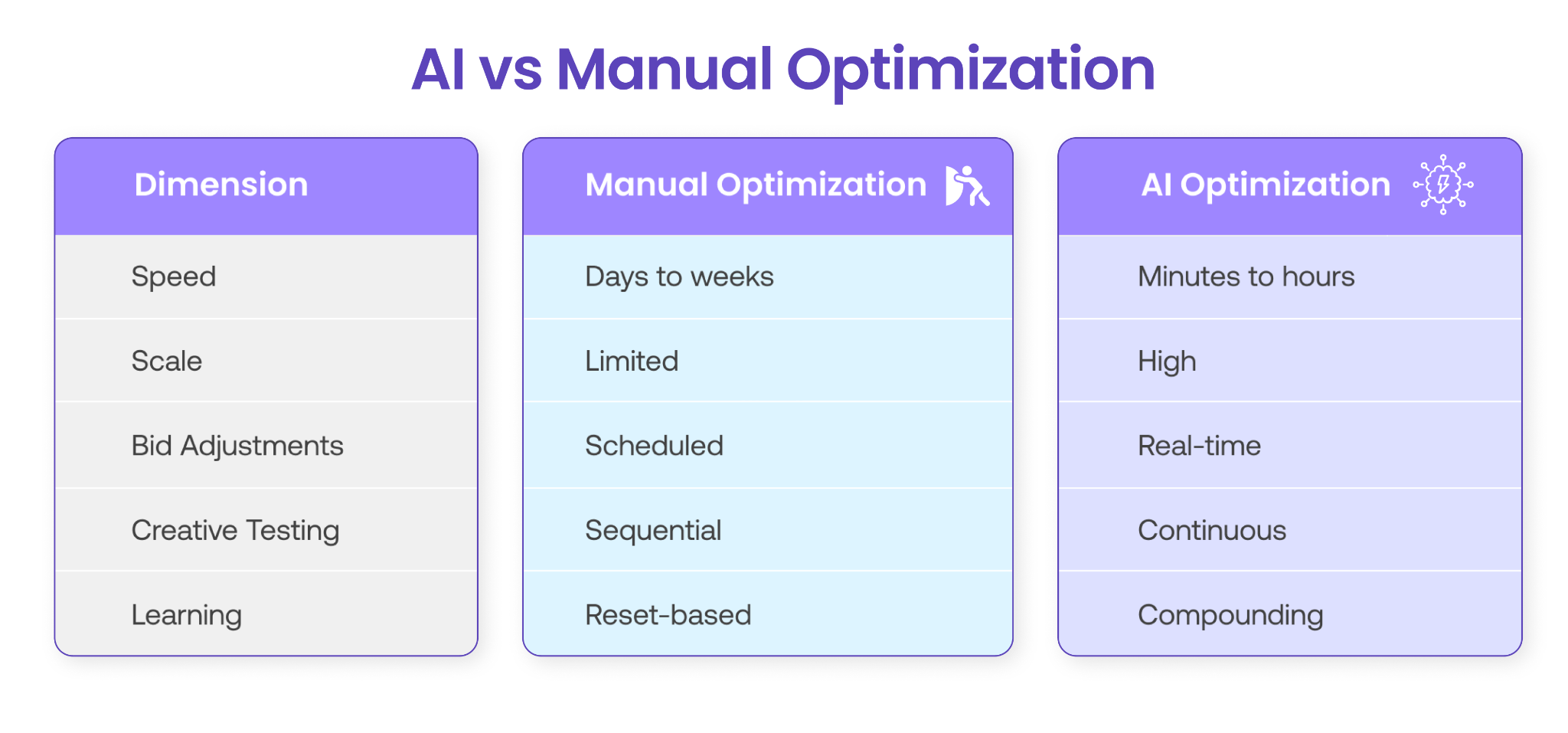
A/B testing compares a few variations sequentially, while AI tests multiple variables simultaneously and continuously optimizes performance.
Is AI ad optimization better than manual optimization?
Yes. AI can process large volumes of data and make decisions in real time, while manual optimization is slower and limited in scale.
How do platforms like Maino.AI use AI for ad optimization?
Platforms like Maino.AI automate budget allocation, creative testing, and performance optimization by continuously analyzing campaign data and making real-time decisions.
Can AI platforms like Maino.AI help reduce cost per acquisition (CAC)?
Yes. AI-driven platforms can reduce CAC by identifying inefficiencies quickly, reallocating budget to high-performing areas, and scaling successful creatives and audiences.
Does AI replace marketers?
No. AI handles execution, but marketers are still responsible for strategy, creative direction, and defining campaign goals.