
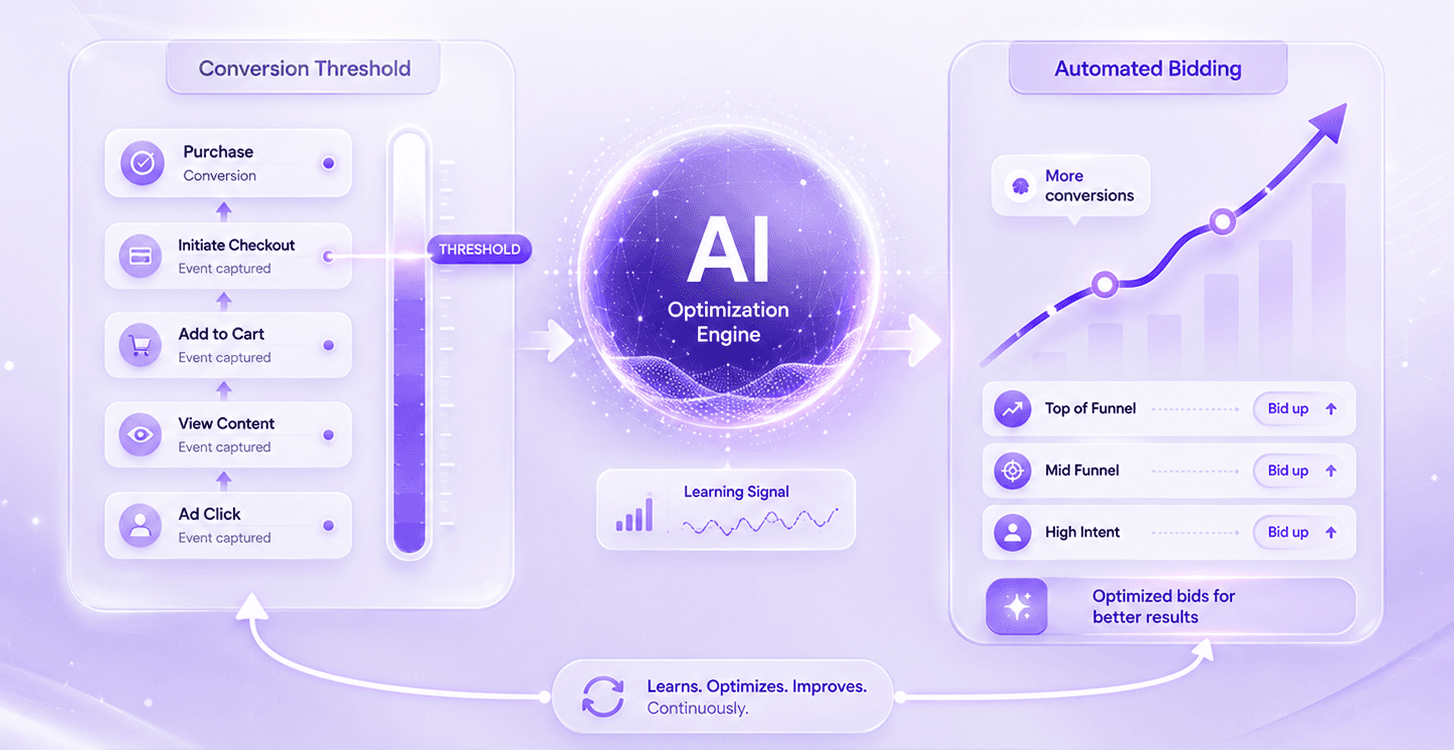
How Much Conversion Data Automated Bidding Actually Needs
Quick Answer
Automated bidding needs a minimum signal volume to beat a fixed split. Google Smart Bidding wants about 30 conversions in 30 days at the campaign level, and Meta needs 50 optimization events in 7 days per ad set. Below the automated bidding conversion threshold, the model treats noise as signal.
For years, marketers set bids by hand and split budgets on instinct. You read a CPA report, nudged a keyword bid up 10%, and moved spend toward whatever campaign looked strong last week. Automated bidding replaced that judgment with a model that reprices every auction in real time. The shift only pays off above a minimum signal volume, and most teams cross the automated bidding conversion threshold without checking whether they have the data to support it. Below that line, the model’s CPA estimates carry more noise than a fixed split would. This post names the thresholds on each major platform and explains what to do when you sit under them.
Quick Summary
Google Smart Bidding needs roughly 30 conversions in the past 30 days at the campaign level before Target CPA reliably outperforms manual control.
Meta requires 50 optimization events per ad set within a rolling 7-day window to exit the learning phase.
Below these thresholds, automated CPA and ROAS estimates carry enough variance to underperform a simple fixed budget split.
The smart bidding minimum conversions count is per campaign or ad set, not per account, so fragmented structures starve each unit of signal.
Consolidating conversion actions and widening attribution windows raises effective signal volume without buying more traffic.
Why automated bidding needs a signal floor
Automated bidding is a prediction system. It receives historical conversion data, estimates the probability that a given auction will convert, and sets a bid against that probability which is the core logic behind modern AI ad optimization.
A model trained on 8 conversions cannot separate converting users from random variation. With 30 or more conversions in a tight window, it has enough examples to find a stable pattern. The automated bidding conversion threshold exists as a practical floor, not a marketing number.
Marginal CPA is the cost of the next conversion at current spend, not the campaign’s historical average. Automated bidding optimizes against marginal CPA, and that estimate is only as reliable as the conversion count behind it. Thin data produces wide confidence intervals, and wide intervals produce bids that swing.
What the minimum conversion thresholds are on each platform
Each platform publishes its own floor, and the numbers reflect how their models train rather than an industry constant. Knowing both lets you judge whether a given campaign is ready for full automation.
Platform | Minimum signal | Window | What the floor governs |
|---|---|---|---|
Google Ads (Target CPA) | ~30 conversions | Last 30 days | Reliable Smart Bidding performance at campaign level |
Google Ads (stable performance) | 40-50 conversions | Last 30 days | Lower bid volatility versus sitting at the minimum |
Meta (ad set) | 50 optimization events | Rolling 7 days | Exiting the learning phase |
Google recommends at least 30 conversions in the past 30 days for Target CPA to perform well. Meta uses around 50 optimization events in 7 days as its learning phase floor. The published minimum is the point below which the model stops outperforming a human’s fixed allocation. Google measures over 30 days while Meta measures over 7, so the same monthly conversion count can clear one floor and miss the other.
How systems separate the decision from the execution
The thresholds above govern execution inside a single platform. The harder problem sits one level up, where budget moves across channels that each measure conversions differently. A campaign clearing Google’s floor can still be starved if account-level logic pulls its budget toward a noisier channel.
Systems like Maino separate decision logic from execution. The platform determines what should happen across campaigns, and each connected channel handles how. “Manthan reduces manual campaign operations by up to 85%,” which frees teams from the constant hand-tuning that low-signal automation otherwise demands.
This separation matters because the smart bidding minimum conversions rule applies per platform, but allocation decisions span all of them. Centralizing the decision while letting each channel keep its native bidding intact preserves both signal integrity and cross-platform control.
Thin conversion data makes a fixed split the safer choice
Below the threshold, a fixed budget split outperforms automated bidding because it does not chase noise. Automated bidding reacts to every conversion as evidence, so with 12 conversions a month it treats statistical scatter as signal and reallocates against it. A fixed split holds steady and lets data accumulate.
The consequence is specific. Teams that switch a low-volume campaign to Target CPA often watch CPA spike for two weeks, then blame the strategy and revert, which resets learning again. The bids were never converging, because the data could not support convergence. Each reset destroys the partial signal the model had collected.
The corrective action is to delay automation until the campaign clears its floor on its own under manual or maximize-conversions control. Build the conversion volume first, then hand the model a dataset it can actually learn from. Patience here is a strategy, not a delay.
When the thresholds stop being enough
The floors assume conversions are clean, recent, and consistent. Three conditions break that assumption even when the raw count looks healthy which is why how the Conversions API recovers signal loss matters before you trust a conversion threshold at face value.
Long sales cycles distort the window. A B2B campaign with a 45-day consideration period may record 30 conversions monthly, but those conversions reflect spend from six weeks ago, so the model optimizes against a stale picture. Shorten the optimization event to a mid-funnel action that fires closer to the click.
Conversion fragmentation starves each unit. Splitting one goal across five micro-conversions, or running ten near-identical ad sets, divides 50 events into pockets too small to train on. Consolidate actions and structures before adding automation.
Seasonality voids the recent window. A campaign that hit 40 conversions during a promotion drops to 10 afterward, and the model keeps bidding to the old demand curve. Recheck signal volume after any demand shift, not just at launch.
A campaign that clears its floor with clean, recent, consolidated data gives automated bidding the conditions it was built for. At that point the model beats any fixed split a human would set, because it reprices every auction against current marginal CPA. The skill is not choosing between manual and automated control. The skill is reading whether a campaign has the signal volume to make automation the better choice.
Frequently Asked Questions
How many conversions does Google Smart Bidding need?
Google recommends at least 30 conversions in the past 30 days at the campaign level for Target CPA to perform reliably. Campaigns that hold 40 to 50 conversions monthly show more stable bids than those sitting at the 30 minimum. Below 30, manual or maximize-conversions bidding usually produces steadier results.
What is the Meta learning phase conversion requirement?
Meta requires 50 optimization events per ad set within a rolling 7-day window to exit the learning phase. The count includes pixel events, server-side conversions, and modeled conversions at the ad set level. Significant edits reset the counter, so frequent changes can trap an ad set in learning indefinitely.
When should you not use automated bidding?
Avoid automated bidding when a campaign sits well below its platform’s conversion floor, such as under 15 conversions a month on Google. The model treats random scatter as signal and produces volatile bids. Use a fixed split or maximize-conversions until the volume clears the threshold, then switch.
Can you lower the conversion threshold for smart bidding?
You cannot lower the published floor, but you can raise effective signal volume. Consolidate conversion actions, move the optimization event earlier in the funnel, and merge fragmented ad sets so events pool into one trainable unit. These changes increase signal without buying more traffic.