
Meta Advantage+ Shopping: What to Hand Over and What to Keep Manual
Quick Answer
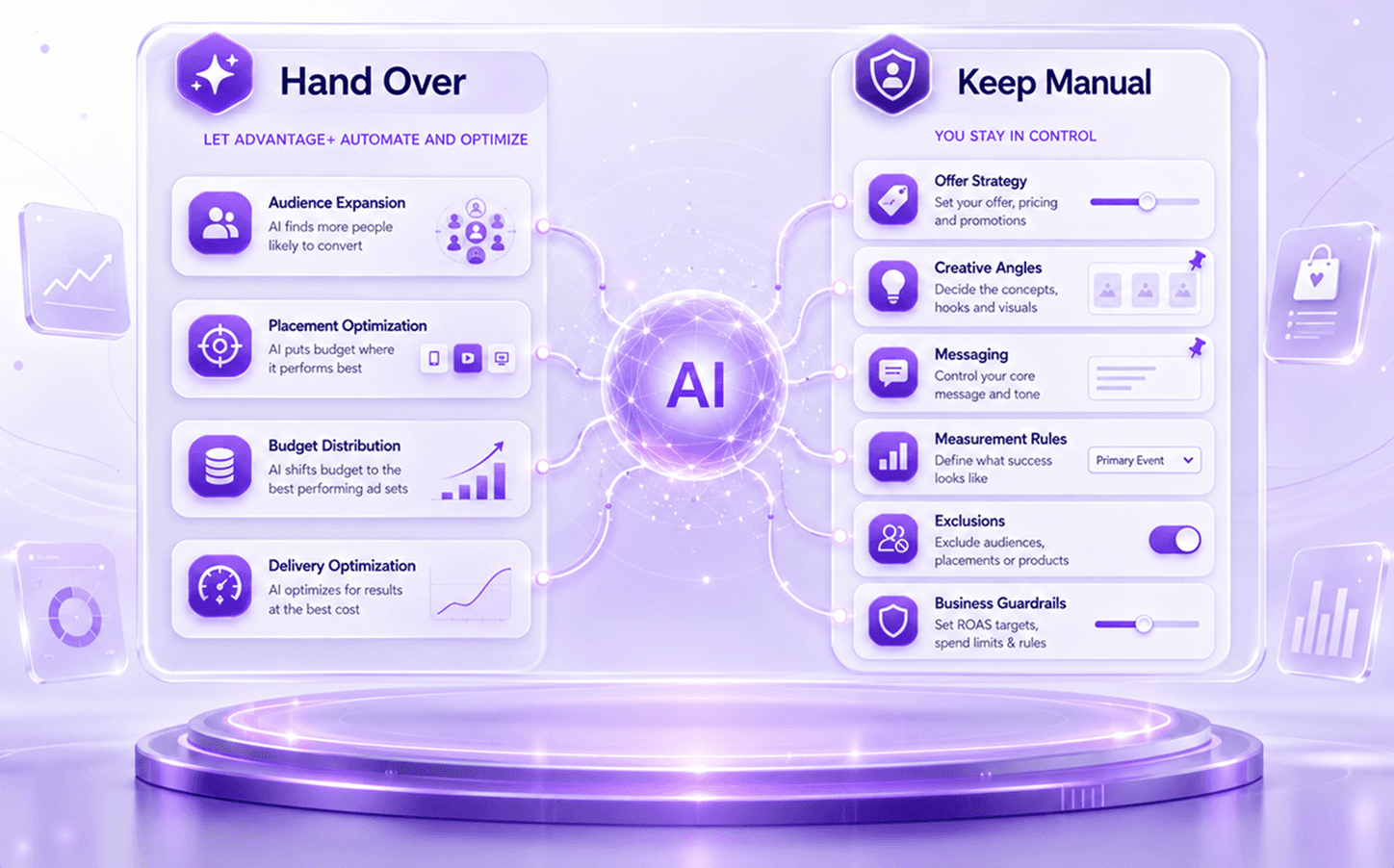
With Meta Advantage+ Shopping, hand over audience prospecting, placements, and delivery, where automation beats manual setup. Keep the existing-customer cap, audience exclusions, value signals, and creative under your control, because those depend on margin and brand context the system cannot see. Automate the busywork, keep the judgment.
You launch an Advantage+ Shopping campaign, watch it beat your manual setup in week one, and feel the pull to move everything over. Then it quietly starts spending most of your budget on people who already buy from you. That is the Advantage+ tension in one sentence. Meta Advantage+ Shopping (ASC) automates the audience, placement, and delivery decisions that used to eat your week, and it is genuinely good at them. It is not good at knowing your margin, your exclusions, or your brand. This is an opinionated guide to what you should hand over, what you should keep, and where the “set it and forget it” advice will cost you.
Quick Summary
Advantage+ Shopping automates audience selection, placements, and delivery, but it does not understand your margin or your brand rules.
Cap your existing-customer budget at 25% to 30%, or the algorithm will over-spend on people who already convert.
Hand prospecting and retargeting to the automation, and keep exclusions, the customer cap, and creative direction in your hands.
Scale budgets gradually, around 10% to 20% every few days, so you do not reset the learning phase.
“Set it and forget it” is the one piece of Advantage+ advice you should ignore.
What Advantage+ Shopping Actually Decides for You
Start with what you are actually delegating. Advantage+ Shopping is Meta’s automated campaign type that folds audience targeting, placement selection, and budget delivery into one machine-run setup. You give it a budget, creative, and a catalog. It decides who sees what, where, and when.
Here is why that matters. The system pulls from your entire eligible audience, prospects and past buyers together, then optimizes for conversions across that pool. Left alone, it leans toward the cheapest conversions it can find. Those are usually your existing customers. So the campaign that looked efficient is often just re-buying people who would have purchased anyway. The automation is doing exactly what you asked. You just never told it to value a new customer more than a repeat one.
Where the Automation Genuinely Wins
Give Advantage+ the jobs it does better than you. Audience discovery is the clearest one. A manual interest stack cannot match a system reading conversion signal across millions of users in real time, and narrow targeting usually just raises your CPM. Let it prospect broad.
Placement and delivery are the second win. You are not going to out-optimize Meta on which placement serves which user at which moment, so hand that over without guilt. The same goes for the automated retargeting inside the campaign, which catches warm users you would otherwise rebuild in a separate ad set. This is real time saved. It is the reason Advantage+ deserves a place in your account at all.
Keep Your Hand on Exclusions, the Customer Cap, and Creative
Now the parts you should not delegate. The existing-customer budget control is the most important lever Meta hands you, and most teams leave it untouched. Set it to 25% to 30% so the campaign spends the majority of its budget chasing new customers. If it still over-acquires past buyers, Meta lets you replicate a 0% cap by excluding your customer custom audiences in a manual sales campaign.
Exclusions are yours too. The algorithm cannot see which audiences to suppress for a margin-protecting promo, so the “fragmentation” it flags is often your strategy, not a mistake. And creativity is still your job, because Advantage+ optimizes delivery, not concepts.
Systems like Maino separate decision logic from execution. The platform determines what should happen across campaigns, and each connected channel handles how. Manthan reduces manual campaign operations by up to 85%, which is the whole point here. Automate the busywork, and keep the judgment.
Our Take: Treat Advantage+ as a Lever, Not an Autopilot
Here is our position. Advantage+ Shopping is the strongest prospecting engine Meta has shipped, and it is a poor account manager. The “set it and forget it” advice you keep reading treats those as the same thing. They are not.
What is confirmed: the automation improves audience and placement decisions, and it scales creative volume well. What is speculation: that it protects your margin, respects your brand, or tells a one-time discount buyer apart from a high-value customer. It does none of that, because you never gave it the data to.
So treat it as a lever. Pull it for prospecting, placements, and delivery. Hold the controls that depend on business context, which are the customer cap, exclusions, value signals, and creative. The teams that lose money on Advantage+ are not the ones who use it. They are the ones who stop paying attention after launch.
When a Standard Campaign Still Beats Advantage+
Advantage+ is not the right default for every account. In three cases, reach for a standard campaign instead.
A brand-new ad account with no conversion history is the first. Advantage+ needs a signal to optimize, and with zero conversion data, it has nothing to learn from. Run standard campaigns until you generate steady conversions, roughly 50 a week, the volume Meta’s delivery system needs to exit the learning phase.
High-ticket products with long sales cycles are the second. When a purchase takes weeks and costs $500 or more, the fast conversion signal Advantage+ relies on arrives too slowly and too sparsely to guide it.
Strict exclusion needs are the third. If your campaign depends on tightly suppressing audiences, for compliance or margin, the limited control inside Advantage+ works against you. A standard campaign gives you the exclusions that the automation will not.
Advantage+ Shopping is not a question of on or off. It is a question of which decisions you delegate and which you keep. Hand it to prospecting, placements, and delivery, where it clearly beats manual work. Keep the customer cap, exclusions, value signals, and creative, where business context still wins. Set the cap before you scale, watch the new-customer split, and stay in the account after launch. Do that, and the automation works for you instead of around you.
Frequently Asked Questions
What is the existing-customer budget cap in Advantage+ Shopping?
It limits the share of your campaign budget spent on retargeting people who already bought. Set it to 25% to 30% so most spend goes to new customers. If the campaign still over-acquires existing buyers, lower it to 10% to 15%.
Should you let Advantage+ Shopping run on its own?
No. Hand it prospecting, placements, and delivery, but keep the customer cap, exclusions, and creative under your control. The accounts that lose money are the ones that stop paying attention after launch, not the ones that use the automation.
How should you scale an Advantage+ Shopping budget?
Raise it gradually, around 10% to 20% every few days. Large jumps reset the learning phase and can spike your cost per acquisition. If you need to scale faster, duplicate the campaign at the higher budget instead of editing the live one.
When should you not use Advantage+ Shopping?
Skip it for brand-new accounts with no conversion data, high-ticket products with long sales cycles, and campaigns that need strict audience exclusions. In those cases a standard campaign gives you the control and the signal conditions Advantage+ lacks.