
Quick Answer
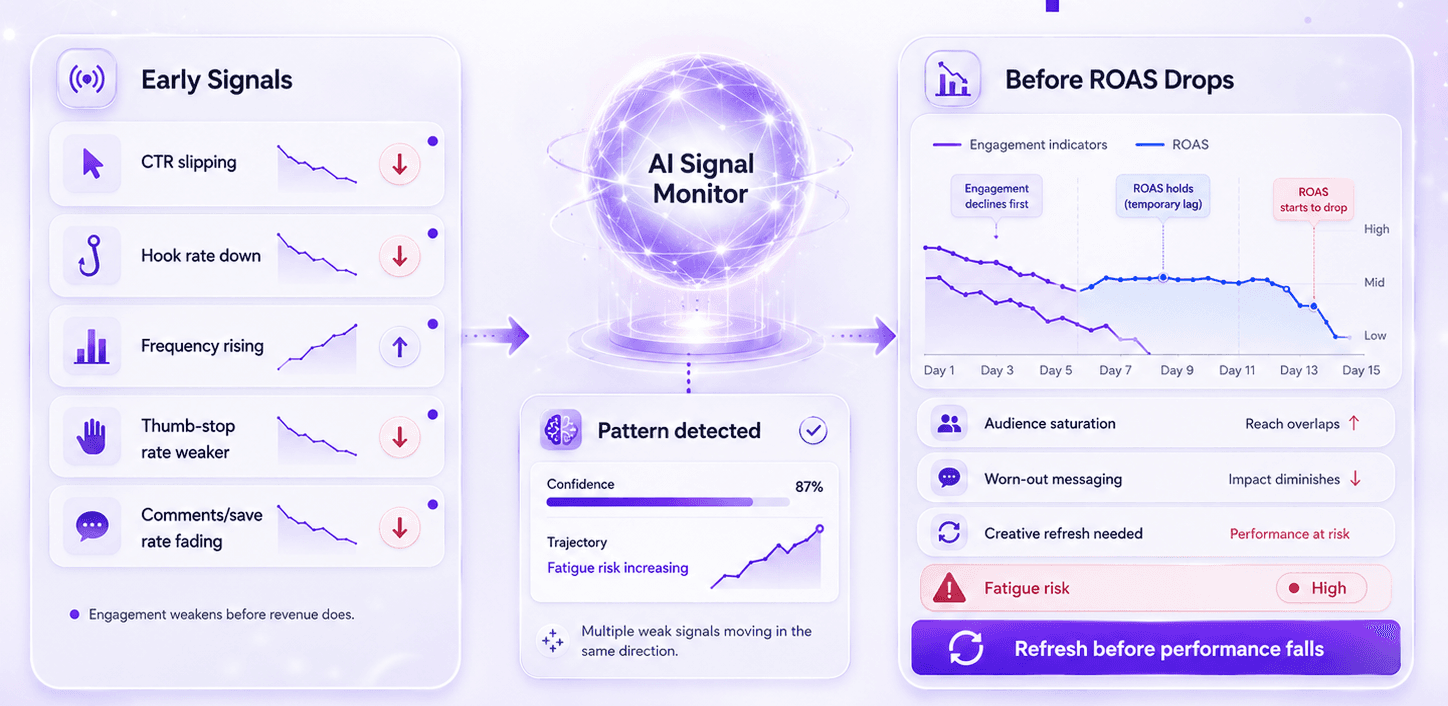
Creative fatigue starts before your ROAS drops because engagement signals decay first. Click-through rate falls and frequency climbs above 3.0 days before revenue confirms the problem. Watch those leading indicators, rotate creative on a cadence, and you stop paying for impressions the audience has already tuned out.
Most teams treat Return on Ad Spend as their creative fatigue alarm. They wait for ROAS to fall, then swap the ad. By then the creative has been decaying for days, and the spend is already lost. Creative fatigue is a drop in audience response to an ad shown too many times. It surfaces first in engagement signals like click-through rate, not in revenue. The capability most teams assume they have, an early warning before ROAS moves, is the one they are missing. This post explains where fatigue shows up first, how to read frequency, and when a drop is not fatigue at all.
Quick Summary
Creative fatigue shows up in engagement metrics days before it appears in ROAS.
A 7-day frequency above 3.0 warrants monitoring, and above 4.0 is a strong fatigue signal for most audiences.
A creative whose click-through rate on day 5 sits 20% below day 1 is an early fatigue candidate.
Fatigue timing depends on format, with Reels fatiguing in 7 to 14 days and feed images holding 14 to 28 days.
Refreshing creative on a schedule prevents the spend you lose while waiting for ROAS to confirm decay.
Creative Fatigue Starts as an Engagement Problem, Not a Revenue One
Creative fatigue begins when the people most likely to respond have already seen the ad. As the system shows the same creative again, it reaches users who are less interested, so click-through rate falls first, which is exactly why Creative Intelligence matters before ROAS confirms the problem. Revenue holds for a while because earlier conversions are still landing. That lag is what fools teams into waiting.
The order matters. Engagement decays, then cost per acquisition rises, then ROAS finally drops. By the time the revenue metric confirms the problem, you have spent days serving an ad the audience stopped responding to. Reading ROAS alone means reacting to the last signal in the chain, not the first.
Engagement Metrics Fall Before ROAS Does
The early signals are specific enough to act on. When click-through rate (CTR) drops 10% over 7 days and cost per acquisition rises 15%, the creative is fatiguing. When CTR falls 20% over 14 days, the decline is serious. A creative whose CTR on day 5 already sits 20% below day 1 is an early candidate for replacement.
These thresholds give you a window ROAS does not. Acting on a 10% CTR decline lets you prepare a replacement before revenue suffers. Waiting for ROAS to confirm the drop forfeits that window, which is why strong AI ad optimization systems use leading engagement signals, not just revenue metrics, to trigger action.. The signal was available days earlier in the engagement data.
Frequency Tells You When a Creative Is Wearing Out
Frequency, the average number of times each user has seen the ad, is the clearest leading indicator. A 7-day frequency above 3.0 signals fatigue setting in for most acquisition audiences. The bands below map frequency to action.
Frequency rises faster in small audiences, so the same creative fatigues sooner when your targeting is narrow. Format changes the timing too. Reels fatigue in 7 to 14 days, while feed images and carousels hold 14 to 28 days. Systems like Maino separate decision logic from execution. The platform determines what should happen across campaigns, and each connected channel handles how. Manthan reduces manual campaign operations by up to 85%.
Rotating on a Schedule Beats Waiting for the Numbers to Drop
A scheduled rotation outperforms reactive swapping because it acts before the decline, not after. When you wait for metrics to confirm fatigue, you have already paid for the impressions that taught you the creative was tired. The decline is not a single event you can catch at the bottom. It is a slope you ride down while you decide.
Teams that swap only on a confirmed ROAS drop run every winning creative slightly too long. The cumulative cost is large across a portfolio, because every ad eventually fatigues and every late swap repeats the same loss. The waste is structural, not occasional.
The corrective action is to set a rotation cadence by format and audience size, then refresh on that schedule unless a creative is clearly still climbing. Let the calendar lead, and use the metrics to make exceptions.
Some Drops Are Not Fatigue at All
Not every engagement drop is fatigue. Some have causes that a new creative cannot fix. Tracking gaps can mimic fatigue. When a measurement change or a broken pixel undercounts conversions, ROAS falls while the creative is fine. Check whether the drop coincides with a tracking change before you blame the ad. Swapping creative here wastes a working asset.
Seasonality is the second case. When demand falls across your category, response drops for every creative at once, not just the tired one. A new ad will not recover demand that left the market. Compare against the same period last year before reacting.
A too-small audience is the third. When your targeting is narrow, frequency climbs quickly and no creative lasts long. The fix is a larger audience, not an endless creative treadmill. Rotating faster only delays the same ceiling.
Creative fatigue is a timing problem you can see coming. Engagement falls first, frequency tells you how close you are, and ROAS only confirms what the early signals already showed. Once you watch the leading indicators and rotate on a cadence, you stop paying for impressions that teach you nothing new. The result is fewer wasted days per creative, and a portfolio that refreshes before performance slips rather than after.
Frequently Asked Questions
How do you know when a Meta creative is fatiguing?
Watch engagement before revenue. A 7-day frequency above 3.0, a 10% CTR decline over a week, or a 15% rise in cost per acquisition all signal fatigue. These move before ROAS does.
How often should you refresh ad creative?
Refresh by format and audience size. Reels tend to fatigue in 7 to 14 days, while feed images and carousels hold 14 to 28 days. Smaller audiences need faster rotation because frequency climbs quicker.
Does a high frequency always mean fatigue?
Not always. Frequency above 4.0 is a strong signal, but a creative still climbing in results can run longer. Read frequency alongside CTR and cost per acquisition, not on its own.
When should you not replace a fatigued-looking creative?
Do not replace it when the drop comes from a tracking change, a broken pixel, or falling category demand. Those are not fatigue, and a new creative will not fix them. Confirm the cause before you swap.