
How Feedback Loops Shape AI Marketing Performance Over Time
Six weeks after launch, budget concentration has already taken shape. One campaign now absorbs ~70% of spend, driven entirely by automated optimization. It also shows the strongest ROAS and conversion volume, so the system’s decision appears correct.
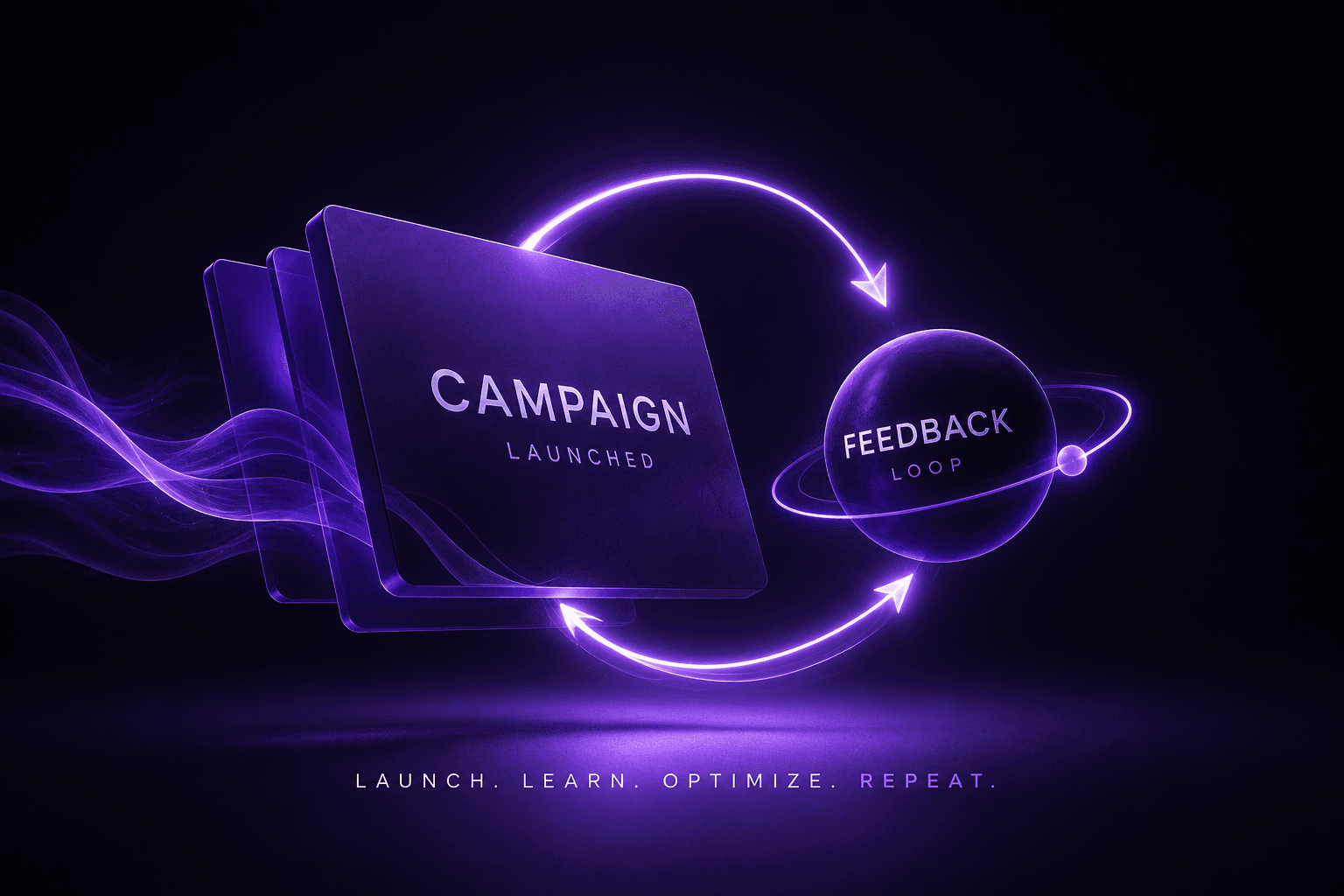
But this is a known pattern in AI-driven systems: early performance signals influence allocation, and allocation influences future performance. Over time, this feedback loop can turn small, noisy advantages into dominant outcomes.
What's Actually Happening: The Feedback Amplification Loop
Early signal advantage → More allocation → More data → Higher confidence → More allocation
The Feedback Amplification Loop is how AI systems turn small early differences into permanent allocation gaps. It doesn't require a clear winner. It only requires a difference, even a noisy, unreliable one, from the first 72 hours of a campaign.
The system reads that difference, allocates slightly more toward the leader, gets more data back from the leader, increases confidence in the leader, and allocates more again. Each step is individually correct. The problem is that repetition makes the gap self-sustaining and eventually, irreversible without deliberate intervention.
The system isn't biased. It's consistent. And in portfolio management, consistency without correction becomes consolidation.
What Your Portfolio Actually Looks Like at Each Stage
Most teams evaluate campaigns in snapshots. The Feedback Amplification Loop is a trajectory problem, what matters is not where campaigns are, but where they're heading and why.
Stage | Leading Campaign | Lagging Campaign | What the System Is Doing |
|---|---|---|---|
Week 1–2 | Slight CPA edge, may be noise | Slightly worse CPA, may also be noise | Reading thin signals, first confidence scores form, tiny allocation difference begins |
Week 3–4 | More conversions (partly from higher budget) | Fewer conversions (partly from lower budget) | Interpreting volume as validity, the gap widens as data density diverges |
Week 6–8 | Dominant budget share, the system is highly confident | Minimal spend, data too sparse for reassessment | Reinforcing historical pattern, recovery now requires deliberate override |
Week 10+ | Still receiving the majority of the budget, even if the audience is saturated | Structurally excluded, would need sustained manual reallocation to recover | Detecting consistency, not opportunity, concentration continues regardless of marginal returns |
Week 10 is where most teams lose money without knowing it. The leading campaign's confidence score stays high because it's built on data volume, not because its next conversion is as valuable as its last one. Diminishing returns are invisible to the loop. Consistency is not.
The Three Campaigns You're Misreading Right Now
The campaign you killed too early: Week-one underperformance reduces delivery, limiting impressions before the system completes learning. Early results reflect unrefined targeting rather than true potential. The campaign was evaluated before sufficient signal was formed.
The campaign you think is your best: High ROAS and stable CPAs are driven by accumulated data and repeated exposure to the same audience. Conversion volume stays high, but incremental value declines. The system rewards consistency, not marginal efficiency.
The campaign you gave up on manually: Short-term budget shifts to low-spend campaigns fail because signal density remains too low for reassessment. Without sustained allocation, the system cannot update confidence, so performance appears unchanged.
Why This Is Hard to See And Harder to Reverse
The Feedback Amplification Loop doesn't produce failure signals. No campaign crashes. No metric collapses. What you see is a tidy portfolio with a clear leader and a system that appears to be doing its job.
That appearance is the trap. The portfolio isn't optimized, it's concentrated. One campaign is being validated continuously on the strength of its own historical data. Others are being assessed on the thin signal of a budget-restricted campaign. The comparison was never fair, and it gets less fair over time.
Reversing it requires more than manual budget shifts. A campaign that's been running at low spend for two months has shallow data. The system's confidence in it is low for a reason, not because the campaign is weak, but because it hasn't been given the conditions to generate depth. Rebalancing works only when the reallocation is sustained long enough for signal density to rebuild. Most teams don't wait that long because they don't see improvement immediately, which is exactly what the loop predicts.
Some AI systems address this directly by separating exploration budget from optimization budget, reserving a portion of spend for campaigns the loop would otherwise deprioritise, specifically to generate signal outside the reinforcement cycle. Maino.ai is built with this kind of decisioning separation, allowing deliberate allocation to run alongside automated optimization without forcing every campaign through the same feedback logic.
The underlying principle is the same regardless of implementation: the feedback loop needs to be interrupted before the gap becomes structural, not after.
Frequently Asked Questions
What is the Feedback Amplification Loop in AI marketing?
The Feedback Amplification Loop (FAL) is the mechanism by which small early performance differences between campaigns compound into permanent allocation gaps over time. A campaign with a slight early advantage receives more budget, generates more data, and builds higher system confidence, which drives further allocation. The loop doesn't require the campaign to be genuinely superior. It only requires it to have had a better start.
Why does a campaign that performed well early keep getting budget even when returns are declining?
Because the system reads data volume as signal quality, a campaign with months of history generates high conversion volume, and high volume produces high confidence, regardless of whether the marginal return on the next dollar into that campaign is still strong. The system measures the reliability of the historical signal, not the efficiency of future spend. Those are different questions with different answers.
Why didn't performance improve when I manually shifted budget to an underperforming campaign?
Because the campaign's data was too sparse for the system to reassess it in a short timeframe. A campaign that's been running at low spend for weeks has low signal density. The system needs enough new conversion data to update its confidence model meaningfully and that takes more than a few days of increased budget. Short-term manual interventions that are withdrawn before the loop recalibrates produce no lasting change.
How is feedback loop bias different from a campaign just being worse?
A campaign that loses the feedback loop competition isn't necessarily weaker, it's data-starved. Its performance is under restricted spend, which reflects the performance of a campaign without adequate signal, not its performance under fair conditions. The only way to separate the two is to sustain adequate spending long enough for the system to form a reliable view. Most teams don't, because early results under the intervention look the same as before it.
When should you intervene in the feedback loop?
Before the gap becomes structural, ideally in the first two to three weeks, when allocation differences are still small and signal density hasn't diverged significantly. Once a campaign has been running at low spend for more than a month, recovery requires sustained reallocation over several weeks, not days. The later the intervention, the longer the runway needed to see a real reassessment from the system.