

How Cross-Platform AI Marketing Systems Actually Work
Campaigns start the day aligned and end it diverging across platforms. Meta reports strong conversion density, Google shows higher intent but lower volume, and Amazon surfaces product-level signals that do not map cleanly either.
The system does not see one performance story. It sees three incompatible signal streams competing for budget.
Cross-platform AI marketing systems step in at this moment not to improve performance directly, but to resolve conflicting signals across platforms. Instead of traditional optimisation, they operate by managing trade-offs between competing inputs.
Most teams assume these systems maximise performance. In reality, they standardise signals first and optimise only after those signals become comparable.
Cross-platform AI marketing systems optimise for consistency under uncertainty, not maximum channel-level performance.
Why platform signals cannot be directly compared
Each platform encodes user behaviour differently:
Meta relies on probabilistic attribution and creative engagement patterns
Google operates on query-level intent
Amazon tracks product-linked purchase behaviour
These are not variations of the same signal. They are structurally different representations of intent. This creates what can be called signal fragmentation, a state where inputs cannot be directly compared without transformation. Before optimisation begins, the system introduces a normalisation layer.
Normalisation is the process of converting platform-specific signals into comparable formats, often at the cost of losing performance-driving context.
What normalisation removes
It enables comparison by compressing signals into fewer dimensions. But it does not just remove noise, it removes differentiation.
The signals that give each platform its edge are the same signals that cannot survive standardisation:
Creative patterns that scale on Meta lose granularity
High-intent search signals from Google get flattened
Product-level insights from Amazon lose precision
The system becomes comparable but less capable of exploiting platform-specific advantages. You gain coordination, but you lose signal richness.
What the system actually optimises for
Once signals are normalized, the system applies a loss function. Cross-platform systems do not directly maximize ROAS. They minimize variance across platforms while maintaining acceptable efficiency. In actual terms, this means the system is balancing:
extracting performance from individual channels
maintaining alignment across them
When these conflict, alignment usually wins. When one platform significantly outperforms:
It is treated as unstable
The budget is reduced
The variance is controlled
The system is not scaling performance, it is stabilising it.
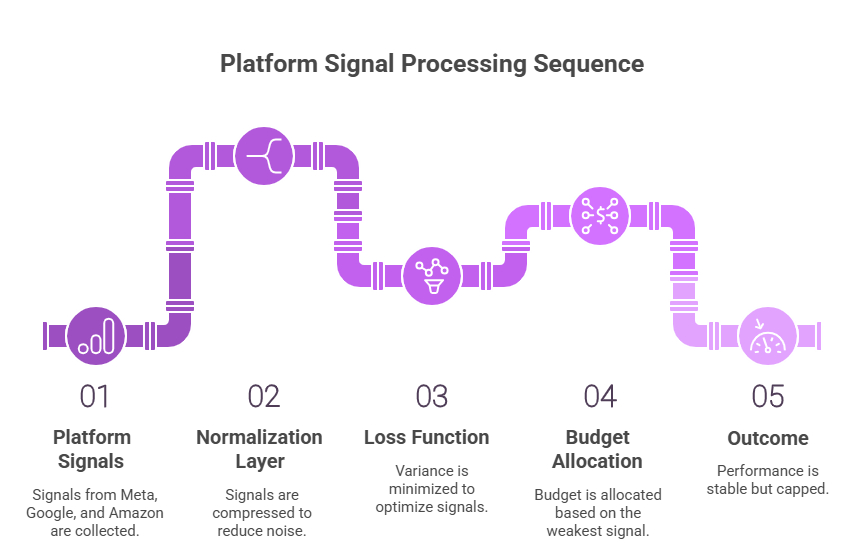
Cross-platform systems compress signals before optimisation, shifting outcomes from performance maximisation to stability.
When the weakest signal becomes the constraint
Budget allocation is driven not just by performance but by confidence in signals and confidence is only as strong as the weakest input. This leads to:
Slower budget shifts
Underutilization of strong signals
Allocation driven by certainty, not upside
This happens because unified systems require validation across all inputs before acting aggressively. In unified systems, budget allocation is constrained by the weakest signal source rather than the strongest performer.
Cross-Platform Signal Trade-off Framework
The real issue is not signal loss, it’s how that loss translates into distorted budget decisions:
Platform | What Actually Drives Performance (Native Reality) | What the Unified System Sees | What Gets Distorted or Lost | Impact on Budget Decisions |
|---|---|---|---|---|
Google (Search) | High-intent, query-level signals with clear user demand | Aggregated intent categories | Keyword precision, query-level conversion patterns | High-intent segments get underfunded as granular search intent is lost in aggregation |
Meta (Social) | Creative-driven behavioural signals (engagement, hooks, fatigue cycles) | Engagement summaries and averaged performance | Creative-level nuance, iteration feedback loops | Winning creatives scale more slowly or get prematurely deprioritised |
Amazon (Commerce) | SKU-level purchase behaviour with direct transaction signals | Generalised product performance signals | Product-level depth, SKU-specific demand spikes | High-converting products lose budget advantage in allocation |
System View (Unified Layer) | — | Normalised, comparable signals across platforms | Platform-specific differentiation | Budget shifts toward stability, not towards the strongest performer |
This distortion doesn’t just remove detail, it changes how performance is interpreted.
When Each Platform Gets Misjudged
Scenario | What the System Concludes | What’s Actually True |
|---|---|---|
Google looks “average” | Intent is moderate | High-value queries are being diluted |
Meta performance fluctuates | Creative is inconsistent | Iteration signals are being flattened |
Amazon looks stable | Demand is steady | SKU-level spikes are being ignored |
Why top-performing channels get suppressed
This is where most teams get confused. You see performance flatten, but nothing looks broken, so there’s no clear signal to intervene.
What’s happening in the background is more subtle. The system starts redistributing budget to maintain balance across platforms. Channels that perform exceptionally well tend to introduce more variance, and that variance is treated as a form of instability. Instead of leaning into those signals, the system gradually shifts allocation away from them toward more predictable inputs.
This doesn’t show up like a typical failure. There are no sharp drops, no obvious inefficiencies, and no visible constraints, which is exactly why it’s difficult to detect.
From the outside, it feels like you’re continuing to scale what’s working. In reality, the system is actively stabilising performance, smoothing out differences across channels rather than amplifying the strongest one.
Where cross-platform systems break
These limitations are not edge cases, they are a direct consequence of how unified systems are designed. Cross-platform optimisation assumes that signals across platforms can be made comparable with reasonable accuracy. That assumption holds only when signal quality, volume, and structure are somewhat aligned. Once that breaks, the system starts making decisions on unstable foundations.
1. Signal imbalance
When one platform produces dense, high-confidence signals and another produces sparse or inconsistent data, normalization becomes unreliable.
The system is forced to treat both inputs as part of the same decision layer, even though their reliability differs significantly. In such situations:
Strong signals get diluted
Weak signals introduce noise
Allocation slows down due to uncertainty
The system does not fail explicitly, it becomes conservative.
2. Rapid creative or audience shifts
Cross-platform systems depend on stable patterns to normalize and compare signals effectively. When creatives are refreshed aggressively or audience structures change quickly:
Platform-specific signals shift faster than the normalization layer can adapt
The system continues optimizing based on outdated abstractions
This creates a lag effect where:
Performance signals exist
But the system cannot fully act on them in real time
3. Early-stage campaigns
In early stages, conversion volume is low and signal density is weak. Without sufficient data:
Normalization lacks statistical reliability
Loss functions become unstable
Budget allocation becomes erratic or overly cautious
In these scenarios, platform-specific optimization often outperforms unified systems because it operates on native signals without requiring cross-platform validation.
How this shows up in real campaigns
These dynamics rarely present themselves as obvious system failures. Instead, they show up as subtle constraints on growth. Teams often observe:
Campaigns that perform well initially but plateau earlier than expected
Budget increases that do not translate into proportional returns
High-performing segments that stop scaling despite strong underlying signals
What makes this difficult to diagnose is the absence of clear negative indicators.
CPMs remain stable
Conversion rates do not collapse
No single platform appears broken
The system continues to produce acceptable results, which masks the underlying constraint. In reality, what you’re seeing is controlled underperformance. The system is actively managing variance across platforms, which leads to:
Partial utilisation of strong signals
Redistribution of spending toward weaker but stabilising inputs
Slower overall growth despite localised efficiency
Without understanding this mechanism, teams often misattribute the issue to:
creative fatigue
audience saturation
bidding inefficiencies
and end up making changes that do not address the root cause.
What does this change in practice
Understanding how these systems behave changes how you structure decision-making. The shift is not about abandoning cross-platform AI it’s about using it within the boundaries it was designed for. Cross-platform systems are effective when:
signal quality is relatively consistent
The goal is a stable, predictable performance
Coordination across channels is more important than maximising a single one
They become limiting when:
One channel clearly outperforms others
High-intent segments exist within specific platforms
Aggressive scaling is required
This leads to a more hybrid approach:
Use cross-platform systems to coordinate budgets and maintain baseline efficiency
Allow high-performing channels to operate with fewer constraints
Override system decisions when signal confidence is uneven
Some systems approach this differently by introducing a separation between decision-making and execution layers, enabling coordination without fully abstracting away platform-specific signals.
Platforms like Maino.AI are designed around this model, where system-level decisioning guides campaigns while execution continues to leverage platform-native signals.
This is not about rejecting automation, it is about controlling where automation applies and where it should not.
Frequently Asked Questions
If cross-platform systems reduce performance, why do teams use them at all?
Because they reduce volatility. In environments where multiple channels contribute to outcomes, coordination becomes more valuable than extracting maximum efficiency from a single source. Cross-platform systems trade upside for stability, which is often desirable at scale.
Why doesn’t the system just allocate more budget to the best-performing channel?
Because performance in a unified system is evaluated relative to other channels, not in isolation. A large performance gap introduces variance, which the system treats as instability. Instead of amplifying the top performer, it redistributes the budget to maintain balance.
Is normalisation always a bad trade-off?
No. Normalisation is necessary for any unified decision-making system. The issue is not that it exists, but that it removes the very signals that make platforms perform differently. It becomes limiting only when those differences are large enough to matter.
Why is this behaviour hard to identify in live campaigns?
Because the system does not fail in an obvious way. Performance doesn’t collapse, it plateaus. Most standard metrics remain stable, which makes the underlying constraint easy to misattribute to external factors like creative fatigue or market saturation.
What’s the difference between platform-level optimisation and cross-platform optimisation?
Platform-level systems optimise within the native logic of each channel, preserving signal richness and exploiting platform-specific advantages. Cross-platform systems operate on abstracted signals, prioritising compatibility and coordination across channels.
When does cross-platform optimisation start becoming a constraint instead of an advantage?
When signal quality is uneven or when one channel clearly outperforms the rest. In these cases, the system’s need for consistency begins to limit its ability to capitalise on strong signals.