

How AI Marketing Systems Handle Uncertainty And Why it Limits Growth
Most marketers operate under one assumption: AI resolves uncertainty better than humans. More data means better predictions. Better predictions mean better decisions. That's the logic.
In practice, the system behaves differently. AI marketing systems don't resolve uncertainty, they reduce exposure to it. When signals are unclear, the system doesn't explore more to learn. It pulls back. Lower bids, smaller budgets, no action at all. That single behavior, repeated across every campaign and every budget cycle, shapes performance more than any individual optimization.
To understand why, you have to see the system as a loop, not a set of isolated decisions.
The Uncertainty Suppression Loop
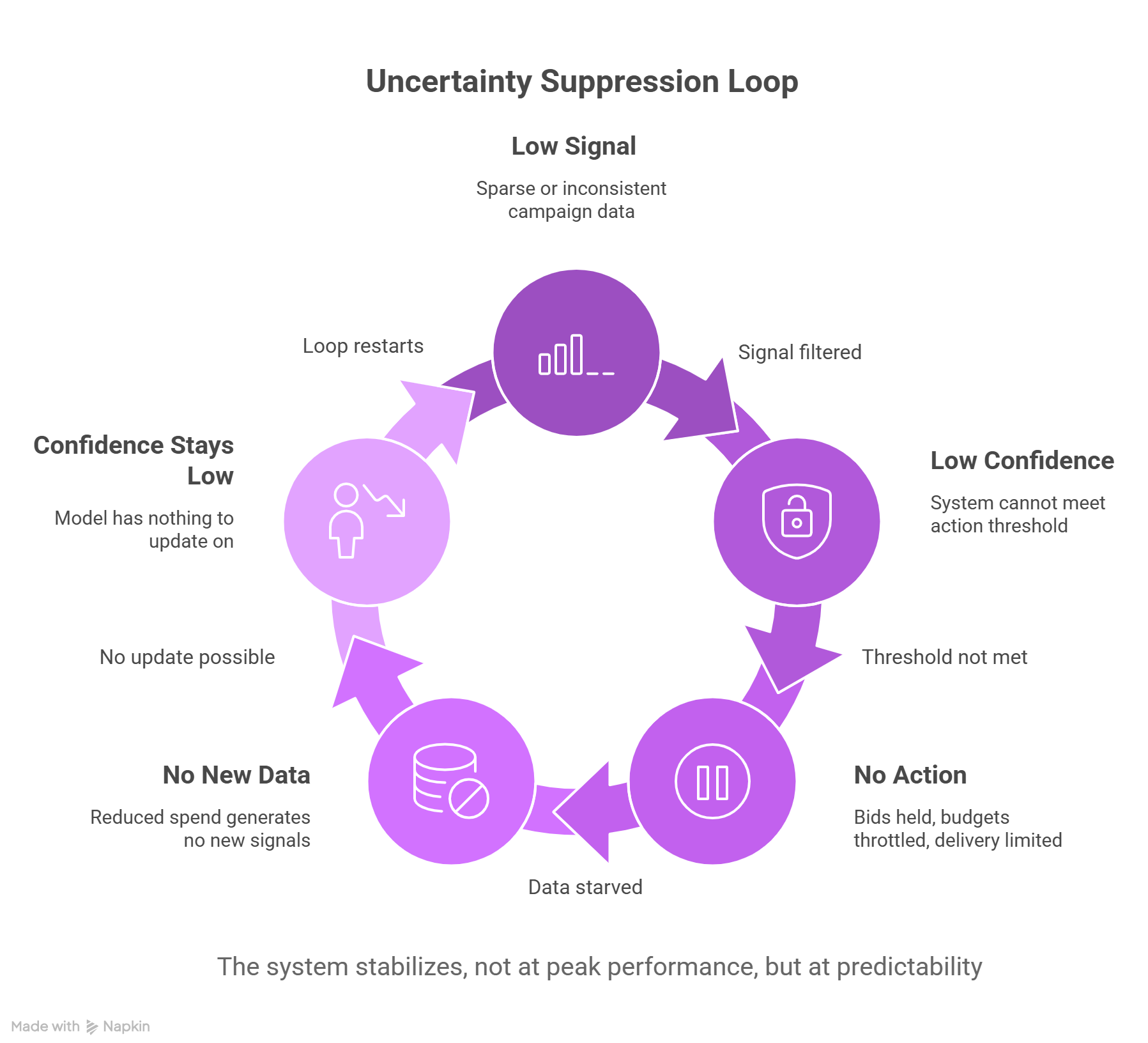
At the core of this behavior is one self-reinforcing mechanism:
Low signal → Low confidence → No action → No new data → Low confidence
This is the Uncertainty Suppression Loop (USL). When confidence is low, the system reduces action. Reduced action limits the generation of new data. Without new data, confidence doesn't improve. The system doesn't recover, it stabilizes inside the uncertainty boundary. It doesn't fail. It stops exploring.
This loop explains why AI systems tend to deepen what they already understand rather than expand into uncertain territory and why that behavior is almost invisible until you know what to look for.
How the Loop Operates: Stage by Stage
Stage 1 — Signal Input: The system reads past performance: conversions, engagement rates, revenue consistency. When this data is stable and sufficient in volume, the system treats it as a strong signal. When it's thin, recent, or inconsistent, confidence drops and the system begins filtering its own actions.
Stage 2 — Confidence Threshold: Every bid adjustment, budget allocation, and delivery decision requires a minimum confidence level before the system acts. This isn't a soft preference, it's a hard gate. Below the threshold, the system defaults to inaction or minimal action. It doesn't choose the safer path; the safer path is the only available path.
Stage 3 — Action Reduction: With confidence below threshold, spend is pulled back. Bids stay conservative. Budgets don't scale even when manually pushed. New creatives get throttled. New audiences receive limited delivery. The system isn't hiding opportunit, it's filtering it through a confidence lens that the opportunity hasn't earned yet.
Stage 4 — Data Gap: Reduced action produces reduced data. A campaign that doesn't spend doesn't generate clicks, conversions, or behavioral signals. Without those signals, the model has nothing new to learn from. Confidence remains flat.
Stage 5 — Loop Closes: The system stabilizes. Not at optimal performance. at predictable performance. This state looks acceptable on a dashboard. Metrics hold steady. Nothing appears broken. But underneath, the system is actively avoiding the conditions required for growth.
The loop restarts from Stage 1 in the next cycle, with the same low confidence and the same outcome.
The Budget Allocation Consequence
The loop has a direct and measurable effect on how budgets are distributed. This isn't a theoretical concern, it shows up in every campaign portfolio running at scale.
Confidence Level | Signal Condition | System Behavior | Budget Outcome | What's Actually Happening |
|---|---|---|---|---|
Low | Sparse, inconsistent, or new data | Action reduced or stopped | Near-zero spend | High-potential campaign starved before it can prove itself |
Moderate | Some historical data, inconsistent conversion patterns | Cautious scaling with guardrails | Gradual, capped increases | Partial gains captured; upside systematically underweighted |
High | Dense, stable, high-volume conversion history | Aggressive allocation | Budget concentration on proven campaigns | Returns plateau as the same audiences get re-targeted |
Artificially High | System confidence inflated by volume, not quality | Over-allocation to a single channel or creative | Budget locked into a single pattern | Growth capped by false signal stability |
The last row matters. Campaigns with high confidence aren't always high quality, they're high data volume. A campaign that has run for months accumulates confidence through sheer repetition, even if the underlying audience is saturating. The system doesn't detect diminishing returns, it detects consistency. Those are not the same thing.
Over time, the budget concentrates around what's predictable, not what's optimal. New campaigns, untested creatives, and unproven audiences rarely accumulate the data needed to clear the threshold, so they never scale, and the system never finds out if they should have.
Framework: The Uncertainty Suppression Loop
Where This Shows Up in Live Campaigns
This isn't theoretical behavior, it's the default operating logic inside platforms like Google Smart Bidding and Meta Advantage+. Both systems gate delivery and spend behind predicted outcomes. Those predictions require data volume and consistency that new or uncertain campaigns simply don't have.
When a campaign lacks sufficient data, three things happen simultaneously:
Bids stay conservative. The system won't increase bids without a reliable predicted conversion rate. Without high bids, delivery is limited. Without delivery, conversions don't accumulate.
Learning phase extends. The "learning phase" in most platforms is a direct output of the Uncertainty Suppression Loop, the system is waiting for enough signal to cross its internal confidence threshold. Campaigns that don't generate sufficient conversions per week stay in learning indefinitely.
Creative and audience testing gets throttled. New creatives get limited impressions until they outperform existing ones. But the comparison is asymmetric, the existing creative has historical data, the new one doesn't. The bar to clear is set against an opponent with a head start.
The result is a portfolio that looks healthy in aggregate, stable CPMs, consistent conversion rates, predictable ROAS, while high-potential campaigns quietly starve.
Why the System Is Designed This Way
Understanding the intent behind this behavior matters. The Uncertainty Suppression Loop isn't a bug, it's the design logic made explicit.
Mistakes at scale are expensive. An incorrect decision at $1,000/day is recoverable. The same error at $100,000/day can set a brand back by months. Systems built to operate at scale are designed to prefer inaction over large negative outcomes, even if that means missing significant upside.
Stable feedback is required for learning. Too much experimentation introduces noise into the model's training signal. If budgets shift constantly toward uncertain campaigns, the loss function becomes unstable. The system learns worse over time, not better. Conservative behavior protects the quality of future predictions.
Most optimization objectives reward consistency. When a system is evaluated on ROAS or CPA stability, consistent performance scores better than volatile-but-higher performance. The system is optimizing for the metric it's measured on and predictability is often that metric, whether or not it's explicitly stated.
The result is a system that actively protects stability. Growth, by definition, requires moving outside what the system already knows. Those two goals are structurally in tension.
What Marketers Misread And Why
Because the USL produces stability rather than failure, the underlying constraint gets misattributed constantly. Teams observe campaigns that plateau earlier than expected, budget increases that don't translate into proportional returns, and strong-signal segments that stop scaling. Standard metrics remain stable. Nothing looks broken.
So the diagnosis lands on creative fatigue. Audience saturation. Bidding inefficiency. Structural market headwinds. Fixes get implemented for problems that aren't the problem and performance stays flat.
The correct reframe requires three shifts:
Low spend ≠ low potential. The system isn't telling you the campaign is weak. It's telling you it doesn't have enough data to act confidently. Those are different problems with different solutions.
Stable performance ≠ optimal allocation. A stable allocation is a predictable allocation. Predictable is not the same as efficient, and it's certainly not the same as maximum return.
The learning phase is a confidence problem, not a time problem. Waiting longer doesn't fix it. Generating more signal deliberately, even at below-efficiency spend does.
Some AI marketing systems are beginning to architect around this constraint by separating the decision-making layer from the execution layer. This allows coordination across campaigns without fully suppressing platform-native signals. Maino.AI is built around this model, the decisioning layer guides, but execution retains signal fidelity.
Frequently Asked Questions
What is the Uncertainty Suppression Loop in AI marketing? The Uncertainty Suppression Loop (USL) is the mechanism by which AI marketing systems reduce action under low confidence, which in turn limits new data generation, which keeps confidence low. It's a self-reinforcing cycle that causes systems to stabilize within uncertainty rather than learn through it.
Why do new campaigns stay in the learning phase for so long? Because learning phase duration is driven by conversion volume, and conversion volume requires spend, and spend requires confidence. When a new campaign can't generate enough conversions to cross the confidence threshold, the system keeps delivery limited and the loop holds.
Why do proven campaigns keep accumulating budget even when they're saturating? High data volume creates high system confidence, even when that data reflects a saturating audience. The system detects consistency, not diminishing returns. It continues allocating to campaigns with stable signals regardless of whether that stability reflects opportunity or exhaustion.
Why is the USL hard to identify in live campaigns?
Because it produces controlled underperformance, not failure. CPMs stay stable, conversion rates hold, and ROAS remains predictable. There are no sharp drops or error signals. The constraint manifests as a growth ceiling, not a performance collapse which makes it easy to misread as a market or creative problem.
What breaks the loop in practice?
Deliberate signal seeding spending into uncertainty, below efficiency thresholds, specifically to generate the data the system needs to update its confidence model. This requires human override of system recommendations during the early campaign period, which most automated platforms don't encourage by default.