

How AI Transforms Retargeting: Why Timing, Not Recency, Drives Performance
Retargeting systems are built on a simple assumption: users who interacted more recently are more likely to convert. Based on this, most platforms assign users to audience pools for a fixed duration and continue showing ads until that window expires.
In practice, this assumption breaks down quickly.
Some users convert within hours of their first interaction, while others return after weeks without any retargeting exposure. Many users disengage entirely when they are repeatedly shown ads during periods where they have no intent to act. What appears as a targeting problem is, in reality, a timing problem.
AI retargeting systems do not attempt to improve performance by expanding reach or refining audience definitions. Instead, they change the underlying decision logic. The system stops asking whether a user belongs to a retargeting pool and starts evaluating whether the user should be targeted at that exact moment.
This shift introduces a different model of retargeting, one that operates on timing-based eligibility rather than recency-based inclusion.
Quick Summary
Traditional retargeting relies on fixed time windows that do not reflect real purchase behavior
AI systems use predictive models to estimate conversion probability in real time
Users move dynamically in and out of targeting pools based on intent signals
Suppression during low-intent periods improves long-term conversion rates
Performance gains are driven by timing precision, not audience expansion
Why Recency Fails as a Proxy for Intent
Recency-based systems treat time since last interaction as a linear indicator of conversion likelihood. The closer a user is to their last interaction, the higher their assumed intent, and the more aggressively they are targeted.
However, user intent does not decay in a linear or predictable manner. It fluctuates based on a combination of internal and external factors, price sensitivity, comparison behavior, context, and even timing of need. Two users who interacted at the same time may have completely different readiness to convert.
This creates a structural mismatch between system logic and user behavior.
When retargeting is driven by fixed windows:
Users are often targeted during low-intent periods where exposure has minimal impact
High-intent windows can be missed if they fall outside predefined durations
Continuous exposure leads to fatigue, reducing future responsiveness
The system optimizes for consistency of exposure, not alignment with intent. Over time, this leads to diminishing returns, even if audience sizes remain large.
The Shift: From Audience Membership to Moment-Level Decisioning
AI retargeting systems reframe the problem by replacing static audience membership with continuous evaluation. Instead of assigning users to pools for a fixed period, the system calculates the probability of conversion at each point in time and uses that probability to determine eligibility.
This introduces a different operating model. Users are no longer persistently “in” a retargeting pool. Their eligibility is conditional and continuously updated. At any given moment, the system decides whether to show an ad, withhold exposure, or wait for stronger signals.
The change may appear subtle, but it fundamentally alters how performance is generated. Retargeting is no longer about maintaining presence, it becomes about intervening at the right moment. Traditional retargeting optimizes for presence. AI retargeting optimizes for intervention.
The Timing-Based Eligibility Framework
A system where retargeting decisions are based on real-time conversion probability instead of fixed time windows, allowing users to move dynamically between targeting and suppression states.
To understand how this works in practice, it is useful to break the system into its core components. This structure governs how signals are translated into targeting decisions.
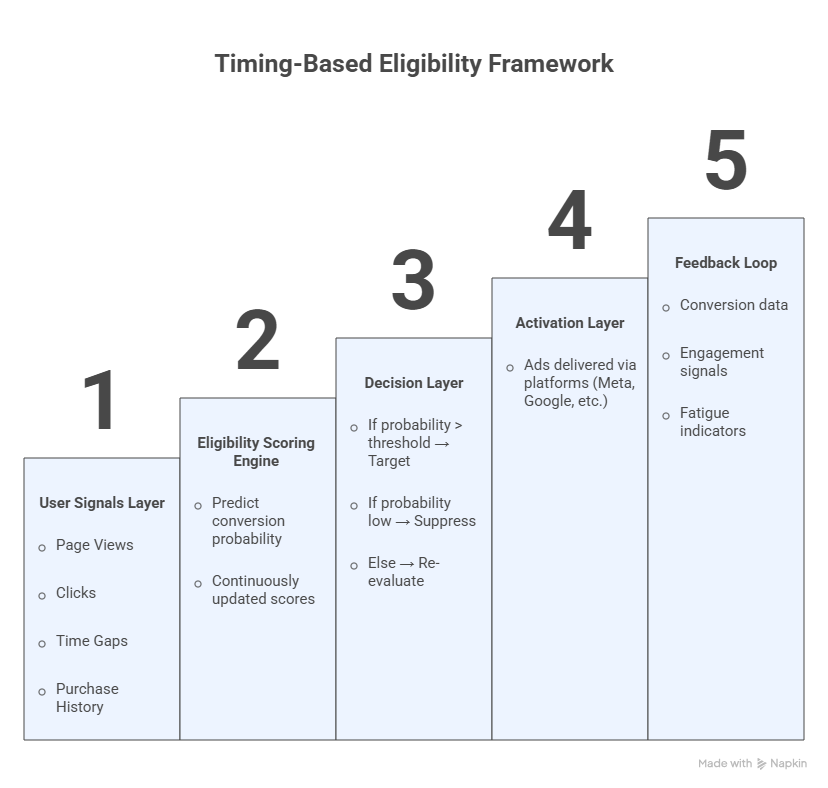
Framework Overview
Signal Layer The system continuously collects behavioral, contextual, and historical signals. These include interaction depth, frequency, time gaps, product views, and prior conversion patterns. The goal is not to track activity alone, but to capture signals that indicate shifts in intent.
Eligibility Scoring Layer These signals are processed through predictive models that estimate the probability of conversion at a given moment. This probability is not static, it evolves as new data is introduced. The output is a dynamic eligibility score rather than a fixed classification.
Decision Layer Based on predefined thresholds, the system determines whether the user should be actively targeted, temporarily suppressed, or re-evaluated later. This layer replaces rule-based inclusion with probability-based selection.
Activation Layer Campaign execution systems (such as ad platforms) deliver ads only when users meet eligibility criteria. The execution is decoupled from the decision logic, allowing updates without restructuring campaigns.
Feedback Loop Conversion outcomes, engagement signals, and fatigue indicators are fed back into the system, refining future eligibility predictions and improving timing accuracy over time.
How Dynamic Eligibility Changes Retargeting Behavior
Once eligibility becomes dynamic, audience behavior changes at the system level.
Users are no longer continuously exposed after a single interaction. Instead, they move in and out of targeting pools based on evolving intent signals. Periods of low probability result in suppression, while spikes in intent trigger reactivation. This creates a non-linear exposure pattern.
Rather than maintaining constant visibility, the system concentrates impressions during high-probability windows. The result is fewer but more effective exposures, where each impression carries a higher likelihood of conversion.
In static systems, more impressions increase exposure. In AI systems, more impressions outside intent windows reduce performance.
Static vs AI Retargeting: Structural Differences
Dimension | Static Retargeting | AI-Driven Retargeting |
|---|---|---|
Core Logic | Event-triggered inclusion | Probability-based eligibility |
Time Model | Fixed duration windows | Continuous evaluation |
User State | Persistent membership | Dynamic activation and removal |
Exposure Pattern | Continuous until expiry | Conditional and intermittent |
Suppression | Minimal or manual | Built into decision system |
Core Optimization Goal | Maintain exposure continuity | Maximize timing precision |
Optimization Focus | Audience reach | Timing precision |
Failure Mode | Overexposure and fatigue | Signal dependency and sparsity |
Suppression as a Performance Mechanism
One of the most misunderstood aspects of AI retargeting is the role of suppression.
In traditional systems, suppression is often treated as a constraint or a safety mechanism. In AI-driven systems, it becomes a primary lever for performance improvement. By deliberately avoiding exposure during low-intent periods, the system prevents unnecessary impressions that would otherwise reduce engagement and increase fatigue.
This has two important effects.
First, it preserves user responsiveness by avoiding saturation. Second, it reallocates budget toward moments where the probability of conversion is significantly higher. Over time, this leads to improved efficiency without increasing audience size.
In this model, performance gains come not from doing more, but from doing less at the wrong time.
Where This Model Breaks Down
Despite its advantages, timing-based eligibility is not universally effective. Its performance depends heavily on signal quality and context.
Sparse Data Environments When user interactions are limited, the system lacks sufficient signals to accurately estimate conversion probability. In such cases, eligibility scoring becomes unreliable, and static heuristics may perform similarly or better.
Very Short Purchase Cycles In scenarios where users convert almost immediately, there is little room for timing optimization. The decision window is too narrow for predictive adjustments to add value.
Privacy-Constrained Ecosystems Reduced tracking and signal availability limit the system’s ability to detect intent shifts. This weakens the predictive layer and reduces the effectiveness of dynamic eligibility.
These are not edge cases—they define the boundaries within which AI retargeting systems operate effectively.
How This Is Implemented in Practice
Systems built on this model typically separate decision-making from execution. Instead of embedding logic directly into campaign structures, they maintain a centralized decision layer that continuously evaluates eligibility and updates targeting behavior.
Platforms like Maino.AI follow this approach by allowing decision systems to guide campaign behavior while execution continues within platform-native environments. This enables continuous updates to eligibility without requiring constant manual intervention or restructuring of campaigns.
The result is a system that behaves less like a set of campaigns and more like a coordinated decision engine.
What This Changes for Marketers
Understanding this shift changes how retargeting performance is interpreted.
If performance declines in a static system, the instinct is often to expand audience size or increase exposure frequency. In a timing-based system, those actions can be counterproductive. The focus moves toward improving signal quality, refining eligibility thresholds, and ensuring that suppression is functioning correctly.
This also changes how success is measured. Instead of evaluating how many users are reached, the emphasis shifts to how effectively impressions are aligned with intent.
Key Definitions
Predictive Eligibility: The estimated probability that a user will convert at a specific moment
Dynamic Re-entry: The process by which users re-enter targeting pools when intent signals strengthen
Suppression Window: A period during which users are intentionally excluded due to low conversion probability
Timing Precision: The degree to which ad delivery aligns with high-intent moments
Frequently Asked Questions
Why does traditional retargeting stop working after a point?
Traditional retargeting relies on fixed time windows that assume intent declines linearly. In reality, intent fluctuates. As users are repeatedly exposed during low-intent periods, engagement drops and conversion probability decreases, leading to diminishing returns.
How does AI decide when to retarget a user?
AI systems use predictive eligibility scoring to estimate the likelihood of conversion at any given moment. Users are targeted only when their probability crosses a defined threshold, ensuring that impressions are aligned with intent.
Does retargeting more frequently improve conversions?
Not necessarily. Increased frequency can lead to overexposure, especially during low-intent periods. AI systems improve performance by reducing unnecessary impressions and concentrating exposure during high-intent windows.
When should you not rely on AI-driven retargeting?
AI retargeting is less effective in environments with limited data, extremely short purchase cycles, or strict privacy constraints. In such cases, the system may lack the signals required to accurately predict timing.
Is AI retargeting about reaching more users?
No. AI retargeting does not significantly expand audience size. Its primary advantage lies in improving when ads are shown, not how many users are reached.