

What Happens When AI Controls Your Ad Budget (And Why It Doesn't Always Do What You Expect)
You're staring at a campaign delivering 4.5 ROAS. You expect the system to pour budget into it. Instead, spend barely moves and a lower-performing campaign continues to receive steady allocation. The numbers look right. The decision feels wrong.
Here's what's actually happening: AI budget systems don't optimize for maximum profit. They optimize for stability. Once you understand this, the decisions stop feeling wrong and you can start working with the system instead of against it.
The Core Insight: Budget Allocation Is a Risk Problem, Not a Profit Problem
AI allocation engines evaluate campaigns on two dimensions simultaneously, expected return and variance in that return. Most marketers only watch the first one.
When a system sees a campaign with 4.5 ROAS but wildly fluctuating daily performance, it doesn't see a winner. It sees an unpredictable asset. Risk-adjusted allocation means the system asks: how confident can I be that this return will hold if I double the budget? If the answer is "not very," spend gets constrained, regardless of the average return.
This is by design. The system is minimizing the probability of performance swings, not maximizing ROAS in any given moment. That's a fundamentally different objective than what most performance marketers have in their heads.
How the System Actually Distributes Budget
1. Variance Scoring Penalizes Inconsistency
Every campaign gets a confidence score based on how consistent its returns are over time. High variance, even with strong averages, reduces that score and caps budget growth.
The counterintuitive result: a campaign with stable 2.8 ROAS will often receive more budget than a campaign averaging 4.5 ROAS with high day-to-day swings. The system isn't ignoring performance. It's weighting reliability as a first-order signal.
2. Smoothing Prevents You from Riding Spikes
After scoring, the system applies budget smoothing spreading spend more evenly across campaigns to avoid sudden reallocation. When a campaign has a strong week, the system doesn't fully capitalize on it. It increases budget gradually to confirm the spike is real, not noise.
By the time it's confident the spike is structural, the window is often over. This delay is a feature for stability, but a cost for peak performance.
3. The Result Is Consistent Underperformance at the Top End
Campaign Type | Variance Level | Budget Allocation |
|---|---|---|
Stable evergreen campaigns | Low | High — receives disproportionate share |
Seasonal or trending campaigns | High | Moderate to low — penalized despite peaks |
New or experimental campaigns | Very high | Minimal — insufficient data, high uncertainty |
The pattern is clear: the system systematically underfunds your highest-opportunity moments in exchange for predictable aggregate performance. For most brands running at scale, this is a rational trade-off, until it isn't.
The ROAS Constraint Framework
Understanding when AI allocation constrains performance and why lets you intervene strategically rather than reactively.
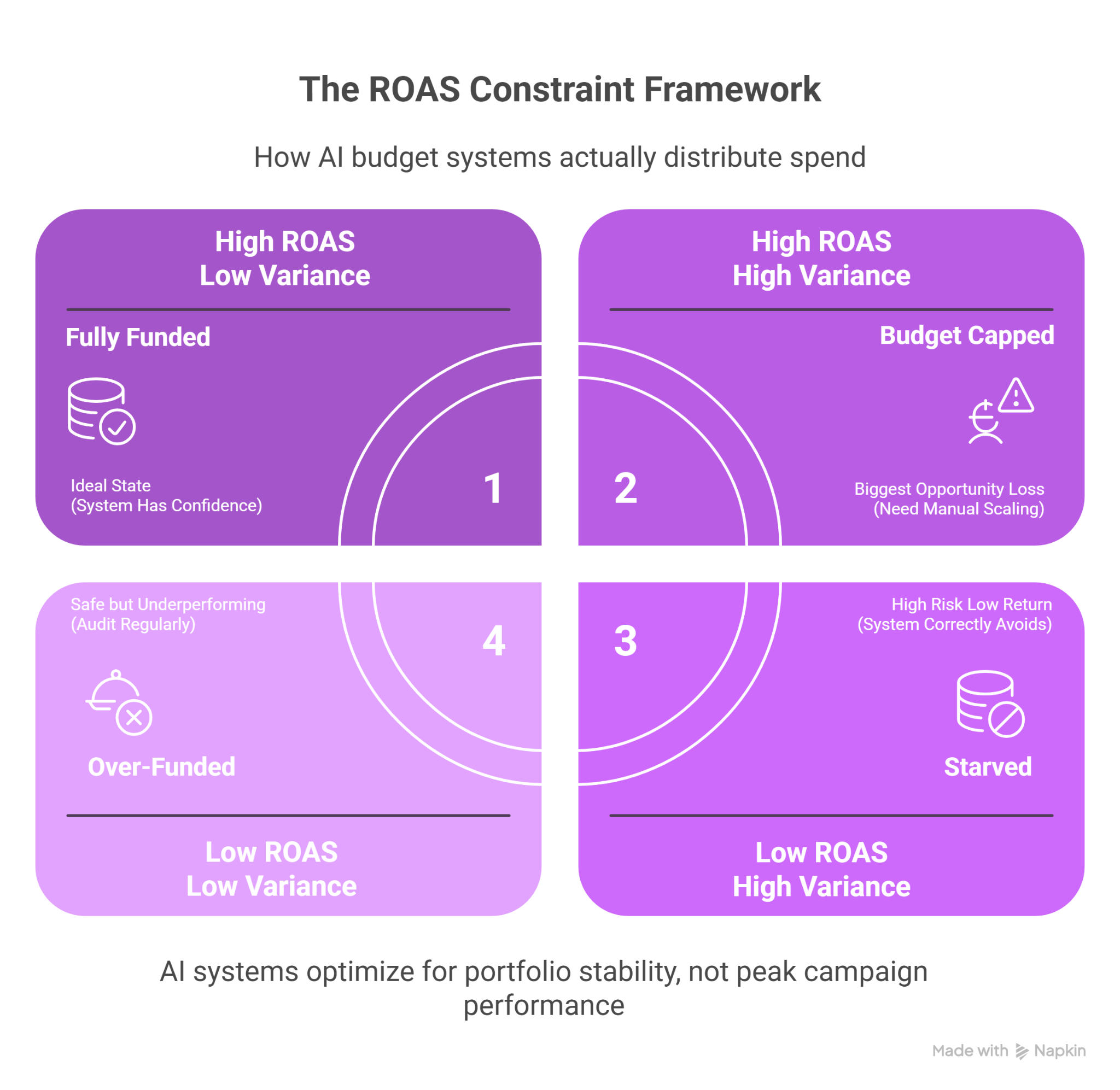
What this means for your strategy:
High ROAS + High Variance campaigns are your biggest opportunity loss. The system is right to be cautious, but these need human-led, controlled scaling, not full automation.
Low ROAS + Low Variance campaigns are getting funded beyond their merit. Review periodically and reallocate manually.
Seasonal or launch campaigns will always be underfunded by default, they have no variance history. You need to intervene early.
Why Manual Overrides Usually Make Things Worse
The instinct when you see an underfunded winner is to manually increase its budget. This feels like fixing the system. It usually isn't.
Manual overrides bypass the risk model. Sudden budget increases expose campaigns to auction volatility the model hadn't priced in. You might see a short-term lift, followed by the system recalibrating, often disrupting adjacent campaigns in the process. The volatility you introduce becomes the new signal the model has to smooth out.
The better intervention: Isolate high-variance, high-potential campaigns into a separate budget pool that's managed with explicit risk tolerance. Let the automated system handle the stable base. This is how platforms like Maino approach it, separating decision logic from execution so interventions are deliberate, not reactive.
Where AI Budget Control Breaks Down
AI allocation works well in steady-state environments with sufficient historical data. It struggles in three specific scenarios:
New product launches — No variance history means the system defaults to maximum caution. You'll consistently under-invest during the window that matters most.
Seasonal spikes — Short, high-intensity periods require aggressive scaling that smoothing explicitly prevents. The system will always lag the curve.
Rapidly shifting markets — When auction dynamics change fast (new competitors, platform updates, macro events), the system continues smoothing based on patterns that no longer apply.
In all three cases, the solution is the same: strategic human override with explicit risk parameters, not blanket automation or blanket manual control.
At Maino, our optimization AI runs 80+ ML models across budget and bid decisions and the most important design principle isn't the models themselves, it's knowing when to hand control back to the marketer. Across our client portfolio, this approach has driven an average 46% reduction in CAC. Not because the AI is always right, but because it's paired with the right human intervention triggers.
How to Act on This System
If you're managing at scale, here's the practical playbook:
Audit your high-variance, high-ROAS campaigns. These are almost certainly underfunded. Don't override blindly, isolate them and scale with controlled budget increments.
Stop expecting the system to ride spikes automatically. It won't. Build a manual review trigger for whenever a campaign posts 3+ days of above-average ROAS.
Treat launches and seasonal campaigns differently from day one. Seed them with budget before the system has variance data. If you wait for the algorithm to recognize performance, the window will have passed.
Resist the random override. If you intervene, document what signal you're acting on. Otherwise you're adding volatility that the system will spend the next two weeks smoothing out.
Frequently Asked Questions
Why doesn't AI allocate more to my top-performing campaigns?
Because top performance doesn't always mean consistent performance. The system evaluates both return and variability. High-performing campaigns with inconsistent daily results get penalized to protect overall portfolio stability.
How does AI decide budget distribution across campaigns?
Through risk-adjusted allocation, weighing expected ROAS against historical variance. Campaigns with stable, predictable returns receive higher budget shares regardless of absolute performance levels.
When should you manually control budget instead of letting AI decide?
During high-growth moments, seasonal peaks, and new launches. These are structurally high-variance scenarios where the system's caution will cost you real performance. Intervene early, with clear budget parameters, rather than reacting after the fact.
Does AI optimize for maximum profit or maximum stability?
Stability. This is the most important thing to internalize. It's not that AI is bad at budget allocation, it's exceptionally good at what it's designed to do. The problem is most marketers assume it's optimizing for the same thing they are.