

Flare: The AI Marketing Intelligence Agent That Already Knows Your Account
Performance marketing does not have a data problem. It has a speed problem.
Most teams today are running on more data than they can realistically process. Dashboards are populated. Reports are scheduled. Metrics are tracked across campaigns, platforms, and time windows. And yet the most consequential question a performance marketer faces on any given morning, what do I actually do next, still takes hours to answer.
The bottleneck is not the absence of data. It is the distance between data and a clear diagnosis. Every morning, someone on the team opens a dashboard, exports a report, pastes figures into a spreadsheet, and manually builds the picture that should have been waiting for them. By the time that analysis is ready, the peak spend window has passed, the underperforming campaign has burned through its daily budget, and the window to intervene has closed.
Flare, Maino's AI marketing intelligence agent built natively into the Manthan platform, is designed to close that gap entirely.
What Is an AI Marketing Intelligence Agent?
An AI marketing intelligence agent is a system that connects directly to a brand's live advertising data, interprets that data in context, and delivers diagnosis and recommended actions without requiring manual analysis in between.
Unlike a reporting dashboard, which presents data and leaves interpretation to the analyst, a marketing intelligence agent understands the account it is working within. It knows the KPIs, the campaign structure, the historical benchmarks, and the metrics that matter most to that specific business. When asked a question, it answers it, rather than returning a dataset that still needs to be read.
Flare is built on this architecture. It enters every conversation already loaded with your account configuration across Meta, Google Ads, your MMP, and your CRM, and it analyzes performance across 390+ metrics without requiring any setup, data pasting, or prompt engineering to orient it toward your business goals.
Always in Context. Never Starting Fresh.
The foundational design decision behind Flare is one that most marketing tools have not made: it enters every conversation already knowing your account.
Flare loads your complete account configuration before a single question is asked: campaigns across Meta and Google, configured KPIs, north-star and target metrics per account, currencies, time zones, and the full catalogue of 390+ metrics available for analysis. There is no setup sequence. No data pasting. No prompt engineering required.
When a marketer opens Flare and asks which campaigns drove the highest drop in their north-star metric over the last 14 days, Flare already knows what the north-star metric is, which accounts are in scope, and what the prior period looked like for comparison. The question gets an answer, not a request for clarification.
This matters because the value of intelligence is inseparable from its timeliness. A diagnosis delivered in 30 seconds is operationally different from the same diagnosis delivered after two hours of manual analysis, even if the conclusion is identical. At meaningful media spend levels, the difference between acting at 9 AM and acting at noon is measurable in budget efficiency and conversion volume.
Four Questions That Drive Every Marketing Day
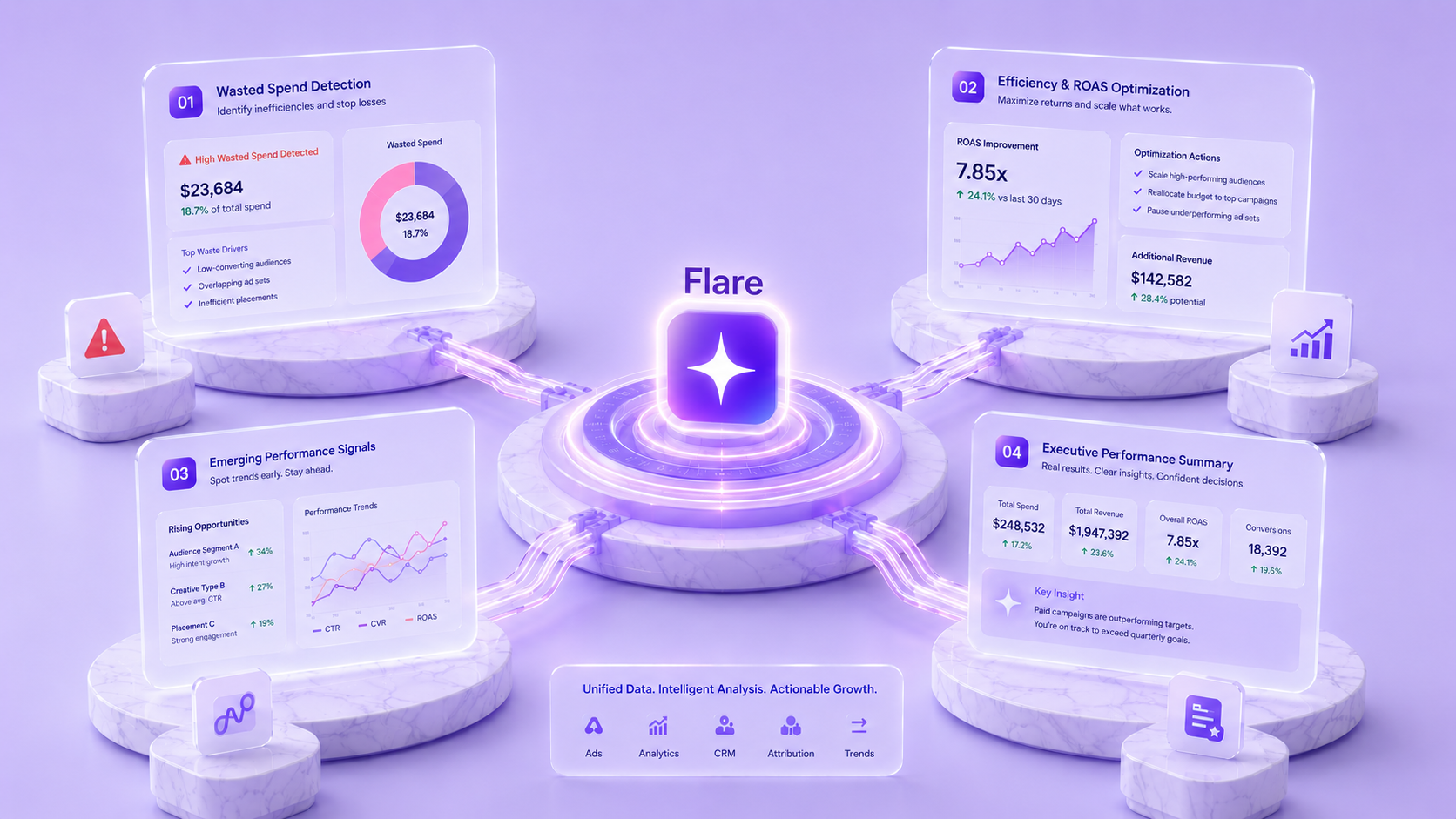
The Flare interface is organized around four categories of analysis that represent the most operationally critical decisions a performance team faces. Each one is not just a query type. It is a structured lens through which account health is assessed.
Identify what is broken or wasting spend. This is the first question any accountable marketer asks when they open their account. Flare answers it with precision: campaigns carrying spend above 1% of total budget with zero conversions over the last 14 days; ad sets with CPI more than twice the account average; budget deployed against placements or audiences where the conversion signal has gone flat. The output is not a list of metrics to interpret. It is a prioritized view of where money is being lost and why.
Find efficiency levers. Beyond identifying waste, Flare surfaces where the same budget, reallocated, would generate superior returns. Campaigns with ROAS below 1.0 absorbing daily spend above threshold. Placements and devices where cost-per-outcome diverges from account benchmarks. Media sources where north-star value per dollar spent is measurably stronger than the portfolio average. This analysis supports the reallocation decisions that separate well-managed accounts from those running on autopilot.
Surface performance signals. Not every important signal is visible in headline metrics. Flare surfaces the underlying movements that precede performance shifts: creative age curves indicating fatigue before CTR visibly drops, impression share losses that reveal whether budget or quality is the constraint, audience overlap percentages that flag cannibalization between campaigns competing for the same users, and keyword Quality Score deterioration that will compound into Ad Rank erosion if left unaddressed. These are the signals that experienced analysts look for. Flare finds them automatically.
Performance digests. For teams that need structured situational awareness rather than open-ended investigation, Flare delivers concise weekly summaries: the top three wins from the prior week, the top three risks requiring attention, and a clear orientation for where leadership focus should be directed. This is not an automated report. It is a synthesized view of account health, built from live data and framed for decision-making at the leadership level.
Analytical Depth Across the Full Performance Marketing Stack
The intelligence inside Flare operates across every layer of the performance marketing stack, not just the headline metrics most tools surface.
Audience overlap and cannibalization analysis. Flare runs pairwise overlap analysis across all active campaigns and ad sets on Meta, computing overlap percentage, union reach, and individual reach for every pair. When two campaigns are competing for the same audience pool, the cost is real: inflated CPMs, suppressed reach, and conversion attribution that obscures true performance. Flare surfaces that cannibalization risk with the specificity required to act on it, identifying exactly which campaign pairs are cannibalizing, by how much, and across what time window.
Google Ads intelligence. On the Google Ads side, the analytical depth extends to capabilities that most reporting tools do not reach. Flare surfaces Search Term Reports sorted by cost, enabling negative keyword identification based on actual spend against zero-conversion queries. This is a systematic approach to eliminating budget waste that most teams address inconsistently. It runs Auction Insights analysis to map competitor positioning at the keyword, ad group, and campaign level, surfacing impression share, overlap rate, and outranking share per competitor domain. It also evaluates Keyword Quality Scores at the component level, breaking down ad relevance, landing page experience, and expected CTR separately, which provides a granular proxy for Ad Rank health that aggregate scores tend to obscure.
Budget structure and pacing intelligence. Flare distinguishes between CBO and ABO campaign structures through budget data logic, surfaces same-day budget changes using the latest-hour value per day, and runs historical budget audits across any time window. It identifies campaigns that are hitting their daily budget caps prematurely, a structural inefficiency that silently limits reach during high-conversion periods, as well as those chronically under-deploying against their allocation. Both conditions represent budget management failures with measurable cost implications, and both are surfaced by Flare without requiring manual investigation.
Creative performance diagnostics. Flare moves beyond aggregate creative performance into the dimensional analysis that actually informs creative decisions. It analyzes performance by creative age, identifying the point at which each creative begins its fatigue curve, as well as by creative tag, feature, and video length. This tells teams not just which creatives are performing, but which creative characteristics are driving performance and at what stage of their lifecycle each asset is operating.
Intra-Day Intelligence and Budget Pacing
One of the most underutilized capabilities in performance marketing analysis is the intra-day view. Most teams review performance once per day, after the fact. By then, budget decisions have already been made, peak hours have passed, and the window to intervene has closed.
Flare operates in dayparting mode, surfacing 24-hour performance rows for any date against a comparison date and identifying the best and worst performing hours of day across any metric. This analysis is available at the campaign, ad set, and ad level, and can be compared against any prior date the team selects. Understanding when your audience converts and structuring bids and budgets accordingly is a compounding efficiency advantage that operates every day at scale.
Pacing mode takes this further. Flare surfaces today's spend and key metrics up to the current hour, compares them against the same hour yesterday, and projects end-of-day outcomes based on current trajectory. For teams managing accounts where daily budget is a hard constraint, knowing at 11 AM whether the account is pacing to exhaust budget by 2 PM, or underspend by 40%, is the difference between proactive management and reactive damage control.
From Diagnosis to Decision
The analytical framework inside Flare is built around a principle that Maino considers foundational: intelligence without a clear path to action is still a reporting problem in different packaging.
Every output Flare produces is framed toward the next decision. When it identifies anomalies, defined as variances of 20% or greater against the comparison window or three or more consecutive periods of directional movement in the same metric, it does not present them as observations. It frames them as decisions: what intervention is indicated, at which level, and with what expected outcome.
This reflects how effective performance marketers actually operate. They do not review data for its own sake. They review data to answer specific questions, make specific decisions, and take specific actions. Flare is built to accelerate that cycle, compressing the time from question to diagnosis to recommended action into a single, continuous conversation.
Analytical Integrity as a Design Principle
An AI marketing intelligence agent operating inside live ad accounts with real budget implications carries a standard of analytical rigor that Maino treats as non-negotiable.
Flare does not fabricate metric keys, platform identifiers, or data. It does not declare a campaign the best performer without an explicit objective against which to measure. It does not characterize a directional movement as a trend on fewer than three data points or less than a 20% delta. It distinguishes correlation from causation in every analysis it produces, and it does not draw conclusions from a partial result set. It verifies completeness before summarizing.
These guardrails are not constraints on Flare's capability. They are the conditions under which its outputs can be trusted by teams making consequential budget decisions. In performance marketing, where a misread signal can result in significant misallocated spend, the integrity of the intelligence layer is as strategically important as its depth.
How Flare Fits Into the Manthan Platform
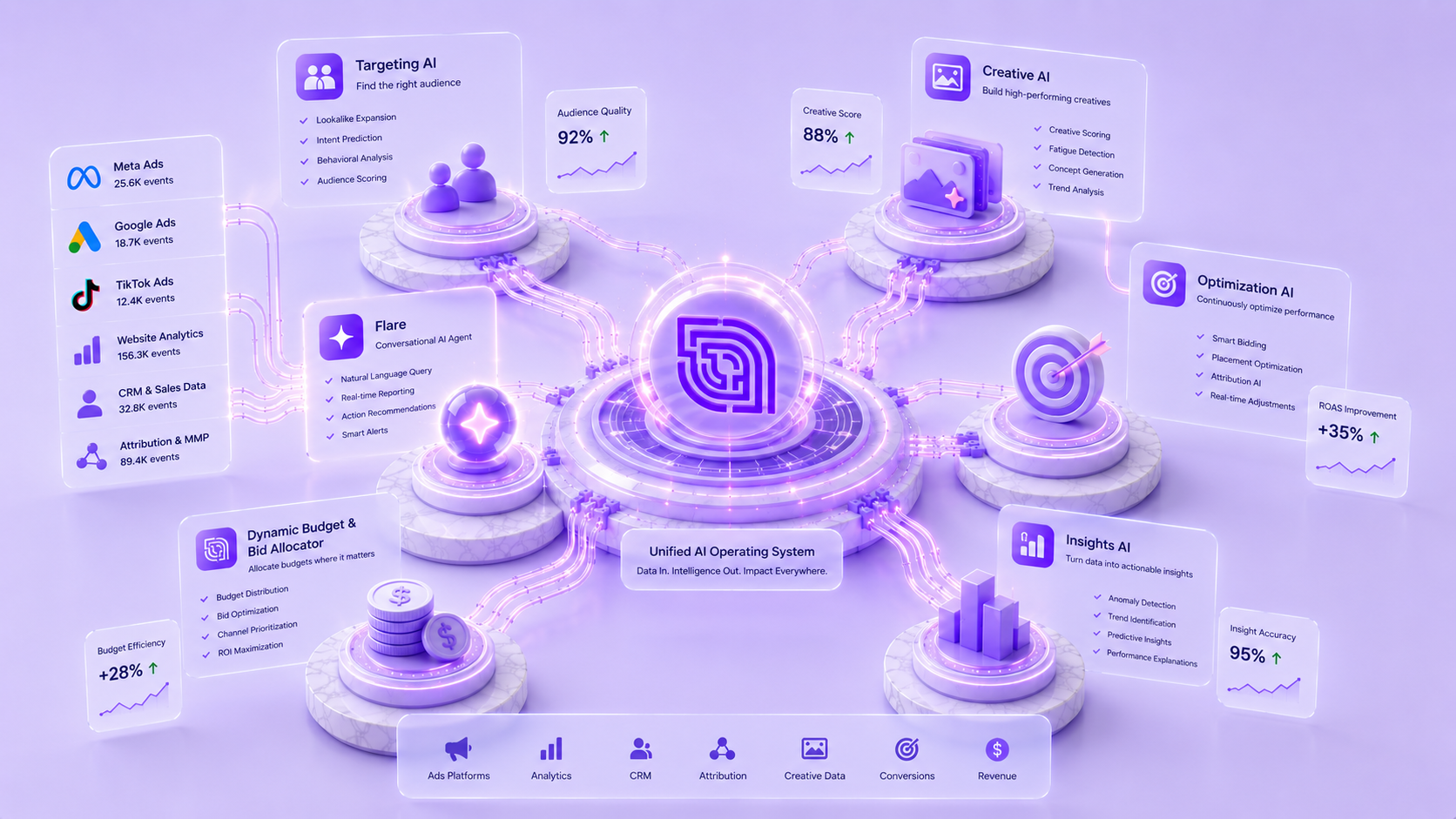
Flare is not a standalone product. It is the conversational intelligence layer of Manthan, Maino's AI-powered performance marketing platform, drawing on the same data infrastructure that powers Targeting AI, Creative AI, Optimization AI, Insights AI, and the Dynamic Budget and Bid Allocator.
The context that Flare surfaces in conversation is not separate from the actions the broader platform can execute. The insight that emerges from a Flare session, whether a budget reallocation opportunity, an audience cannibalization risk, or a creative fatigue signal, feeds directly into the decision-making framework that Manthan's automation layer acts on. The loop from diagnosis to execution is continuous.
For performance marketing teams managing significant media investment across Meta, Google, and an increasingly fragmented platform landscape, that integration is the difference between intelligence as a reporting exercise and intelligence as an operational advantage.
Flare is available now within Manthan.
Ask Flare anything. It already knows where to look.
Frequently Asked Questions
What is Flare?
Flare is Maino's AI marketing intelligence agent, built natively into the Manthan platform. It connects directly to your ad platforms, MMP, and CRM, and enters every conversation already loaded with your full account configuration, so teams can move from question to diagnosis to recommended action without any manual setup or data preparation in between.
What is an AI marketing intelligence agent?
An AI marketing intelligence agent is a system that connects to live advertising data, interprets it in the context of a specific account's goals and structure, and delivers actionable diagnosis without requiring manual analysis. It differs from a reporting dashboard in that it understands what the data means for that account, not just what the numbers are.
What platforms does Flare connect to?
Flare connects to Meta, Google Ads, your MMP, and your CRM. It pulls live account data across all connected sources and analyzes performance across 390+ metrics.
How is Flare different from a standard reporting dashboard?
A dashboard presents data. Flare interprets it. Rather than requiring a team member to export, aggregate, and manually construct an analysis, Flare surfaces prioritized findings, flags anomalies, and frames every output around the decision that follows, not just the metric that changed.
What kinds of questions can I ask Flare?
Flare is designed around the four most operationally critical questions a performance team faces: where is budget being wasted, where are the efficiency levers, what signals are emerging beneath the headline metrics, and what is the overall health of the account this week. Beyond those structured categories, it handles intra-day pacing questions, audience overlap and cannibalization analysis, creative fatigue diagnostics, and competitive positioning via Auction Insights.
How does Flare define an anomaly?
Flare flags a movement as an anomaly when it represents a variance of 20% or greater against the comparison window, or when three or more consecutive periods show consistent directional movement in the same metric.
Does Flare make budget changes automatically?
Flare is an intelligence layer, not an execution layer. It surfaces the diagnosis and frames the recommended action. Execution happens through Manthan's broader automation capabilities, including the Dynamic Budget and Bid Allocator, which operates on the same underlying data infrastructure.
What is Manthan?
Manthan is Maino's AI-powered performance marketing platform. It brings together Targeting AI, Creative AI, Optimization AI, Insights AI, the Dynamic Budget and Bid Allocator, and Flare into a single integrated system, enabling brands to make faster, more evidence-driven decisions across every dimension of performance marketing.
Is Flare available now?
Yes. Flare is available within the Manthan platform. To learn more, visit maino.ai.
Flare is Maino's AI-powered marketing intelligence agent, available within the Manthan platform. To learn more about Manthan and the full Maino ecosystem, visit maino.ai.