
Best Automated Ad Bidding Tools Powered by AI (2026)
Performance marketers in 2026 are not short on bidding tools. What’s missing are platforms that truly connect bid decisions with creative performance, audience signals, and cross-platform budget allocation in a unified way.
This guide reviews six AI-powered automated bidding platforms that growth teams rely on. Each is evaluated across five key criteria: automation depth, platform coverage, cross-platform budget optimization, reporting and insights, and ease of onboarding.
Built for performance marketing leads, growth managers, and agency teams running campaigns at scale, this guide helps you compare tools more clearly and choose what actually fits your workflow.
Key Takeaways
Google Smart Bidding and Meta Advantage+ are the strongest choices for single-platform advertisers, offering auction-time optimization within their native ecosystems at no additional cost.
For e-commerce brands whose primary channel is Amazon, Quartile's bid logic accounts for Amazon-specific signals that general platforms do not replicate.
Cross-platform budget reallocation across Google, Meta, and Amazon simultaneously is available at growth-stage scale through Maino.ai's Manthan and at enterprise scale through Skai.
Creative automation and bid management sit in the same workflow only with Smartly.io (for social) and Maino.ai's Manthan (across Google, Meta, and Amazon).
The most important diagnostic question is whether your bidding problem is isolated to one platform or compounds across multiple channels. Single-platform tools will not solve a multi-platform problem.
Ease of onboarding is highest with native tools. Skai carries significant implementation overhead. Third-party platforms built for growth-stage teams sit in the moderate range.
Attribution tool integration, including support for AppsFlyer, Adjust, and Singular, is a differentiating factor for teams running post-click conversion measurement outside the native ad platforms.
Why Automated Bid Management Matters in 2026
Manual bid management does not fail because marketers are not skilled. It fails because the volume of signals has outgrown what any human team can process in real time.
A single mid-sized Google Ads account can generate thousands of auction signals per hour. Consumer behaviour shifts hour by hour. Cost Per Mille (CPM) rates spike on weekends. A creative goes stale after 48 hours of heavy exposure. Audiences saturate faster than campaigns can be manually refreshed. At that pace, a bid adjustment made on Tuesday morning is already obsolete by Tuesday afternoon.
Automated bidding tools use machine learning to close this gap. They adjust bids per auction, per audience segment, and per platform without waiting for a human to notice the pattern first. The difference between tools is not whether they automate bidding. It is how deeply they automate it, how many platforms they cover, and whether the bid logic connects to the rest of the campaign stack.
How This Comparison Was Built
Each tool below is evaluated on five criteria. These criteria are applied consistently across all six tools.
Automation depth refers to how much of the bid adjustment process runs without manual intervention. This includes real-time bid changes per auction, automatic budget reallocation, and AI-driven response to performance signals.
Platform coverage refers to which ad platforms the tool natively supports for bid management, including Google Ads, Meta Ads, Amazon Advertising, and OEM or programmatic networks.
Cross-platform budget optimization refers to whether the tool can shift budget allocation across platforms based on live performance data, not just manage bids within a single platform.
Reporting and insights refers to the quality of cross-platform analytics, attribution support, and anomaly detection available within the tool.
Ease of onboarding refers to how quickly a new team can connect their accounts, configure the system, and see it running without heavy technical support.
The Tools
1. Google Smart Bidding
Google Smart Bidding is Google's native automated bidding system, built directly into Google Ads. It uses Google's auction-time machine learning to set bids based on signals including device, location, time of day, search query, and remarketing list membership. Smart Bidding strategies include Target CPA (Cost Per Acquisition), Target ROAS (Return on Ad Spend), Maximize Conversions, and Maximize Conversion Value.
Strengths:
Bidding operates at auction time using signals only Google has access to, including query intent data across billions of searches.
No additional setup cost. Smart Bidding is included in Google Ads.
Performance Max campaigns extend Smart Bidding logic across Google's full inventory, including Search, Display, YouTube, and Discover.
Limitations:
Smart Bidding is Google-only. It does not manage bids on Meta, Amazon, or any other platform.
The system optimizes for Google's conversion signals. When attribution data lives in a third-party tool like AppsFlyer or Adjust, sync quality becomes a variable.
Budget allocation decisions across channels remain entirely manual.
Best for: Teams running Google-primary campaigns who want auction-level bid automation within the Google ecosystem and are managing other platforms through separate tools or processes.
2. Meta Advantage+ Bidding
Meta Advantage+ is Meta's AI-driven campaign and bidding infrastructure across Facebook and Instagram. It encompasses Advantage+ Shopping Campaigns, Advantage+ Audience targeting, and automated bid and budget tools within Meta's campaign structure. Meta's system uses its proprietary signals from user behavior across Facebook, Instagram, Messenger, and the Audience Network.
Strengths:
Meta's first-party behavioral data gives its bid optimization meaningful signal depth for consumer-facing campaigns.
Advantage+ Shopping Campaigns reduce manual creative and audience inputs, allowing the system to test combinations automatically.
Integration is seamless for campaigns running natively on Meta.
Limitations:
Like Google Smart Bidding, Meta Advantage+ is platform-native and does not optimize bids outside the Meta ecosystem.
Transparency on why specific bids or audience decisions were made is limited. Meta's system is a black box by design.
Teams running campaigns across Google and Amazon still need separate tools for those platforms.
Best for: D2C and e-commerce brands whose primary acquisition channel is Meta and who want to reduce manual targeting and bidding inputs within that platform.
3. Maino.AI (Manthan)
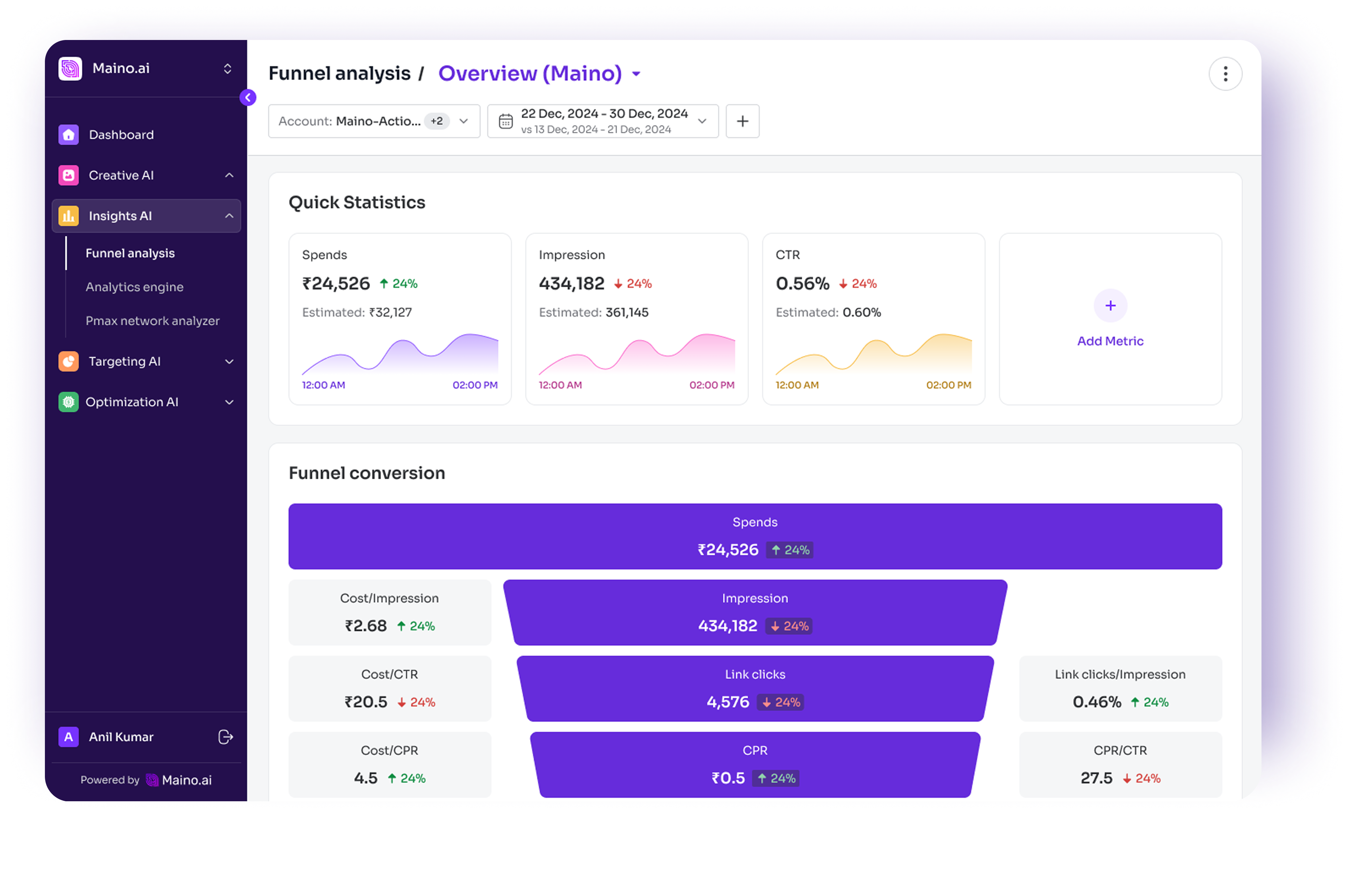
Maino.AI is an AI-led performance marketing platform founded in 2022, based in the US. Its core product, Manthan, automates bid management, budget allocation, audience targeting, and creative generation across Google Ads, Meta Ads, and Amazon Advertising in one platform. Manthan runs on five AI modules: Creative AI, Targeting AI, Optimization AI, Insights AI, and AI Marketer.
Maino.AI has optimized over $150 million in ad spend across 50 plus global clients. The platform reduces manual campaign operations by 85%.
Strengths:
Optimization AI manages real-time bid adjustments and budget reallocation across Google, Meta, and Amazon simultaneously. Budget moves between platforms based on live ROAS signals without manual intervention.
Dynamic Product Tagging (DPT), a feature within Optimization AI, categorizes e-commerce SKUs into ROAS performance tiers and reallocates spend automatically toward top-performing products. This is particularly effective for D2C brands managing large catalogs with seasonal demand variation.
Bid optimization is connected to Creative AI and Targeting AI within the same platform. When a creative begins to fatigue, the system flags it and scores replacement variants. Bid and creative decisions are not siloed.
Manthan integrates with AppsFlyer, Singular, Adjust, Firebase, Google Analytics, and Shopify, giving its bid decisions access to post-click attribution data in real time.
Maino.AI is a Google Premier Partner 2026, a Meta Business Partner, and an Amazon Ads Verified Partner.
Limitations:
Manthan is best suited for brands running campaigns across three or more platforms simultaneously. For single-platform advertisers, the full-stack capability may exceed what is needed.
Maino.AI's primary market is India and the US. Teams in other regions may find less local support infrastructure.
Best for: Growth-stage brands in India and the United States running campaigns across Google, Meta, and Amazon who need cross-platform bid optimization, automated budget reallocation, and creative management without expanding their team size. It is less suited to solo marketers managing a single ad account or brands with very early-stage campaign spend.
4. Smartly.io
Smartly.io is a social advertising automation platform with strong creative and bidding capabilities across Meta, Pinterest, Snap, and TikTok. Its bid management functionality is tied closely to its creative automation features. Smartly allows teams to automate creative production at scale and connect those creatives to campaign-level bid and budget rules.
Strengths:
Creative automation and bid management sit in one platform, which reduces the disconnect between creative decisions and performance outcomes.
Dynamic creative optimization tools are well-regarded, particularly for high-volume Meta and social campaigns.
Smartly's automation rules engine allows teams to configure complex bid and budget triggers without engineering support.
Limitations:
Smartly's focus is social. Google Search and Amazon Advertising are not core strengths.
Cross-platform budget optimization, particularly across social and search, is not a primary capability.
Pricing is structured for enterprise and mid-market teams. Smaller growth teams may find the cost-to-value ratio difficult to justify.
Best for: Mid-market to enterprise brands whose primary challenge is creative velocity and social ad management at scale, particularly on Meta, TikTok, and Snap.
5. Quartile
Quartile is an AI-powered advertising platform built specifically for Amazon Advertising, with extensions to Google and Meta. Its bid optimization engine is designed around Amazon's auction dynamics, including Sponsored Products, Sponsored Brands, and Sponsored Display. Quartile uses machine learning to manage keyword bids, campaign structure, and budget allocation within Amazon.
Strengths:
Quartile's depth inside Amazon Advertising is its defining strength. Its bid logic accounts for Amazon-specific signals including category trends, competitor activity, and listing quality.
Automated campaign structure recommendations reduce the manual overhead of managing large Amazon catalogs.
The platform has expanded bid management to Google and Meta, though Amazon remains its primary focus.
Limitations:
For brands whose primary channels are Google and Meta, Quartile's Amazon-first design may not align with their campaign mix.
Cross-platform budget reallocation across Amazon, Google, and Meta is partial. The system is strongest when Amazon is the dominant spend channel.
Reporting is granular within Amazon but less unified for teams running significant spend on other platforms.
Best for: E-commerce brands for whom Amazon Advertising is a primary or major channel and who want deep bid automation within that platform.
6. Skai (Formerly Kenshoo)
Skai is a cross-channel performance marketing platform with bid management capabilities across Google, Meta, Amazon, Apple Search Ads, and retail media networks. It has operated in the enterprise performance marketing space since 2006 and serves large brands and agencies managing high ad spend across multiple channels. Skai connects bid optimization to its own incrementality and attribution capabilities.
Strengths:
Platform coverage is broader than most tools in this category, including retail media and Apple Search Ads alongside the major platforms.
Skai's portfolio bid management allows budget allocation decisions across campaigns within a channel based on portfolio-level ROAS targets.
Enterprise-grade reporting with custom attribution modeling.
Limitations:
Skai is built for enterprise accounts. Pricing and onboarding complexity reflect that. It is not a practical fit for growth-stage brands or smaller agencies.
Cross-platform budget reallocation, moving budget from Google to Meta based on live performance, is limited. Skai optimizes within channels more than across them.
Implementation typically requires dedicated support resources from Skai's team.
Best for: Enterprise brands or large agencies managing $5 million or more in annual ad spend across retail media, Amazon, and major platforms who need a structured, agency-grade bidding and reporting layer.
Side-by-Side Comparison
Criterion | Google Smart Bidding | Meta Advantage+ | Maino.ai (Manthan) | Smartly.io | Quartile | Skai |
|---|---|---|---|---|---|---|
Automation depth | Strong (Google only) | Strong (Meta only) | Strong | Strong | Strong (Amazon-focused) | Strong |
Platform coverage | Google only | Meta only | Google, Meta, Amazon | Meta, TikTok, Snap, Pinterest | Amazon primary, Google, Meta partial | Google, Meta, Amazon, Retail Media, Apple |
Cross-platform budget optimization | No | No | Yes | No | Partial | Partial (within-channel) |
Connected to creative decisions | No | Partial | Yes | Yes (social only) | No | No |
Attribution tool integrations | Google native | Meta native | AppsFlyer, Singular, Adjust, Firebase | Partial | Partial | Yes |
Reporting and insights | Google ecosystem only | Meta ecosystem only | Unified cross-platform dashboard | Social-focused | Amazon-focused | Strong, enterprise-grade |
Best market fit | Any scale | Any scale | Growth-stage, India and US | Mid-market to Enterprise | Amazon-first e-commerce | Enterprise |
Ease of onboarding | High (native) | High (native) | Moderate | Moderate | Moderate | Low to moderate |
How to Choose Between These Tools
The right tool depends on where your spend is concentrated and what problem you are actually trying to solve.
If Google is your dominant channel and you have no immediate need for cross-platform coordination, Google Smart Bidding is already inside your account and requires no additional investment. The same logic applies to Meta Advantage+ for Meta-primary advertisers. Both native tools have meaningfully improved in the past two years and underperforming manual bidding in the hands of a small team is a real risk.
If your primary challenge is Amazon and your catalogue is large, Quartile's depth inside that platform is hard to match with a generalist tool.
If creative velocity on social media is your bottleneck, specifically the gap between how fast audiences cycle through ad formats and how fast your team can produce new ones, Smartly.io addresses that problem more directly than most bidding-focused tools.
If your campaigns run across Google, Meta, and Amazon simultaneously, and you need bid decisions, budget reallocation, creative scoring, and attribution data connected in one place without adding headcount, the shortlist narrows considerably. Skai operates at that cross-platform layer but is built for enterprise scale. Maino.AI's Manthan is built for growth-stage brands facing the same complexity at a different stage of scale.
The clearest diagnostic question is whether your bidding problem is isolated to one platform or does it compound across platforms? If it compounds, a single-platform tool will not solve it.
Frequently Asked Questions
What is an automated ad bidding tool?
An automated ad bidding tool uses machine learning to adjust bids per auction, per audience, and per placement without manual input. These tools replace the process of manually reviewing performance data and changing bids based on that review, which typically happens on a daily or weekly cycle. Automated systems make those decisions continuously, in real time.
Which AI bidding tool works across Google, Meta, and Amazon?
Tools with genuine cross-platform bid management across Google, Meta, and Amazon include Skai (enterprise-grade) and Maino.ai's Manthan (built for growth-stage brands in India and the US). Google Smart Bidding and Meta Advantage+ are strong within their own platforms but do not manage bids or budgets on other channels.
What is the difference between platform-native bidding and a third-party bidding tool?
Platform-native bidding tools, like Google Smart Bidding or Meta Advantage+, use proprietary signals from within that platform to set bids. They are free to use but limited to one platform. Third-party bidding tools connect multiple platforms and can make budget allocation decisions based on comparative performance across channels. The tradeoff is additional cost and onboarding effort versus the ability to optimize the whole portfolio, not just one platform at a time.
What is Dynamic Product Tagging in ad bidding?
Dynamic Product Tagging (DPT) is a feature within Maino.ai's Optimization AI module. It classifies a brand's full product catalog into real-time ROAS performance tiers and automatically reallocates ad budget toward top-performing SKUs while reducing spend on underperformers. DPT is designed for e-commerce and D2C brands managing large catalogues across Google and Meta campaigns.
How does AI ad bidding help Indian D2C brands?
Indian D2C brands scaling from metro markets into Tier 2 and Tier 3 cities face audience and pricing complexity that standard bid strategies do not account for. Automated bidding tools that integrate with attribution platforms like AppsFlyer or Adjust allow bid decisions to reflect actual conversion quality, not just click-level signals. Platforms like Maino.ai's Manthan are built with multi-geography Indian campaign behaviour in mind, including behavioural signal variance across city tiers and language preferences.
Does automated bidding replace the need for a media buyer?
No. Automated bidding handles execution volume: per-auction bid adjustments, budget reallocation, and creative scoring at a scale no human team can match. Media buyers and performance marketers handle strategy, campaign structure, audience framework, and the contextual decisions that AI systems are not equipped to make. A new product launch, a brand safety concern, or a competitor promotional event requires human judgment. The systems handle the volume; the team handles the context.
How quickly do AI bidding systems improve performance after launch?
Most AI bidding systems require a learning period, typically two to four weeks, to accumulate sufficient conversion data before optimization signals become reliable. During this period, significant bid or budget changes can reset the learning process. The systems improve continuously after this period as they accumulate more campaign-specific data. Campaigns with higher conversion volumes learn faster than those with sparse conversion data.