

The Continuous Optimization Loop: How AI Improves Campaigns Over Time
You increase a budget. Nothing moves for two days. Then ROAS ticks up and CPAs start to tighten. You attribute it to the budget change, maybe to a creative swap you made around the same time.
Neither of those is the real cause. The system didn't make a better decision, it accumulated enough small corrections, across enough cycles, for the effect to surface. That accumulation is the Continuous Optimization Loop. And until you understand how it actually works, you'll keep misreading what your campaigns are telling you.
What the Continuous Optimization Loop Actually Is
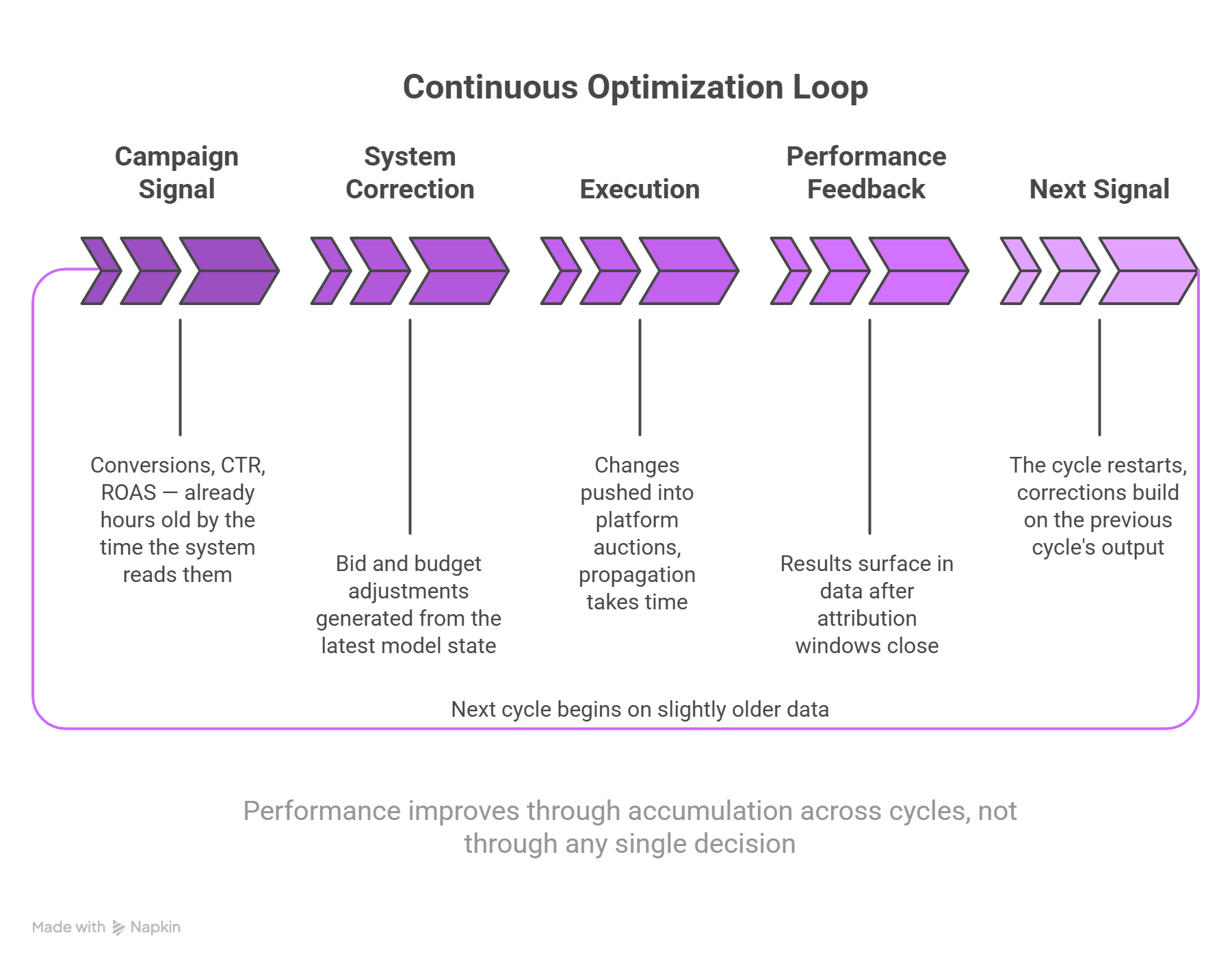
Campaign signal → System correction → Execution → Performance feedback → Campaign signal
The Continuous Optimization Loop (COL) is the repeated cycle through which AI systems improve campaign performance, not in one move, but across many small adjustments that compound over time.
Each cycle, the system reads what happened, makes a correction, pushes that change into the auction, and waits for the result. That result becomes the input for the next correction. No single cycle produces a visible jump. The gains are in the accumulation.
This is why AI-managed campaigns feel slow at first and then suddenly seem to "click." Nothing clicked. The loop just ran enough cycles.
Why Your Campaign Doesn't React Immediately
The loop is called continuous, but it doesn't run instantaneously. Between each stage, reading performance, generating a correction, pushing a change, getting results back, there's a gap. And those gaps matter more than most teams realize.
The system reads yesterday's campaign, not today's. By the time performance data is aggregated and processed, it's already reflecting what happened hours ago. In fast-moving categories, competitive auctions, seasonal spikes, viral content, the market has already moved.
Bid and budget changes take time to propagate. A decision made by the system isn't applied the moment it's generated. It enters a platform queue, gets distributed across auctions, and only shows up in your data after delivery has started reflecting the new parameters. On Meta and Google, this propagation can take several hours.
Conversion data arrives late. The system can only learn from conversions once they're attributed and attribution windows run anywhere from same-day to 28 days depending on platform settings and purchase cycle length. For a D2C brand with a 7-day click window, the system is making today's decisions based on purchases that happened last week.
The result: the system is always optimizing toward the recent past, not the present. That's not a flaw, it's how every AI marketing system operates. But it means that when you make a change and nothing moves immediately, it's not because nothing happened. The loop just hasn't completed enough cycles for the correction to surface in your numbers.
How Corrections Compound Into Real Performance Gains
The compounding effect is what makes the loop valuable — and what makes it easy to misread.
A 3% reduction in CPM from one cycle's bid correction changes which auctions you enter. That changes your impression mix. That changes your CTR. That changes your conversion volume. That changes what the system predicts for the next cycle. Over ten cycles, a 3% correction becomes a structurally different campaign than the one you started with.
But that compounding only works under one condition: signals have to stay stable enough for each correction to build on the last one.
Loop Frequency | Stable Campaign Environment | Volatile Campaign Environment |
|---|---|---|
Low | Slow improvement; gains accumulate but take longer to show | Frequent misalignment; corrections are outdated before they take effect |
Moderate | Consistent lift cycle-over-cycle; corrections stay relevant | Partial alignment; visible lag when audience or creative shifts happen |
High | Strong compounding; system stays tightly calibrated | Over-correction; the system reacts to noise instead of real trends |
The counterintuitive finding here is that more frequent optimization is not always better. When you're rotating creatives aggressively, testing new audiences weekly, or running in highly competitive auctions that shift daily, high-frequency corrections can make performance worse, not better. The system is reacting to fluctuations before they stabilize into actual signals.
Loop frequency needs to match the environment, not a default setting.
Framework: The Continuous Optimization Loop
Why Campaigns Plateau Before They Should
Most performance marketers have seen it: a campaign runs well, you increase budget, performance holds for a week, then flattens. You assume it's audience saturation or creative fatigue. You swap creatives. You expand targeting. Neither fixes it.
What's actually happening is a loop problem, not a campaign problem.
The loop plateaus when the speed of market change outpaces the speed of correction. Auction dynamics shift. A competitor changes their bidding. A creative starts fatiguing. The system generates corrections, but by the time those corrections reach the auction, conditions have already moved. The loop keeps running, but it's always one step behind. Gains flatten not because there's no opportunity but because the system's corrections are perpetually arriving late to the right market state.
Three situations where this shows up consistently:
Budget scales faster than signal volume. You double the budget, but conversion volume doesn't double immediately. The system now has more spend to allocate but the same signal density informing those decisions. Corrections become less precise at higher spend, and performance per rupee drops until the new signal volume catches up.
Creative rotation is faster than the loop cycle. You're launching new creatives every few days to beat fatigue. But the system needs several cycles to form a stable view of each creative's performance. Before it can correct meaningfully, you've already swapped it out. The loop never gets traction, and performance stays uneven.
Attribution windows are misaligned with purchase cycle. If your buyer takes 5 days to convert but your attribution window is 1-day click, the system is making bid decisions with almost no conversion data. Every correction is based on incomplete feedback. The loop runs but on a fraction of the signal it needs.
In all three cases, the diagnosis that leads somewhere isn't "what should we change in the campaign?" It's "what's preventing the loop from correcting accurately?"
What Marketers Misread And Why
Because the loop produces gradual, compounding gains rather than visible jumps, teams consistently misread what's happening.
They attribute gains to the last decision they made. The creative swap, the audience change, the bid strategy switch. In reality, the improvement was already accumulating across several prior cycles. The last action happened to coincide with when the gains surfaced.
They attribute plateaus to external factors. Audience saturation. Seasonal softness. Creative fatigue. These are real phenomena but they're also the default explanation when the loop is the actual constraint. A campaign that has plateaued because corrections are arriving late to the market will look identical to one that has genuinely saturated. The metrics are the same. The cause and the fix are completely different.
They treat the learning phase as a time problem. Campaigns in learning are waiting for the loop to accumulate enough signal to make reliable corrections, not for a calendar to turn. The fix isn't patience. It's generating signal volume. Running at slightly below-target efficiency early, to give the loop enough data to calibrate, consistently produces better outcomes than conserving spend during learning.
The correct reframe:
Slow early performance ≠ weak campaign. It means the loop hasn't run enough cycles yet. Don't kill it before it compounds.
A plateau ≠ saturation. Ask whether corrections are arriving on time before assuming the audience is exhausted.
Creative fatigue ≠ the first explanation. If your loop is misaligned with your creative rotation speed, fatigue will look like the problem even when it isn't.
Frequently Asked Questions
What is the Continuous Optimization Loop in AI marketing? The Continuous Optimization Loop (COL) is the cycle through which AI systems improve campaign performance, reading signals, making corrections, executing those corrections in auctions, and using the results to inform the next correction. Gains come from accumulation across many cycles, not from any single decision. The speed and accuracy of the loop determines how fast performance improves and where it plateaus.
Why does performance improve slowly at first even with AI running? Because each cycle only applies a small correction, and those corrections need to compound across multiple cycles before the effect is large enough to show in your numbers. The system is working, the gains just aren't visible until enough iterations have stacked. How long this takes depends on conversion volume and how stable the campaign environment is.
Why doesn't performance improve when I increase budget? Scaling budget faster than signal volume scales creates a mismatch: more spend to allocate, but the same density of conversion data informing those allocations. Corrections become less precise at higher spend. Performance often dips or plateaus temporarily after a large budget increase, then recovers as conversion volume catches up and the loop recalibrates.
Why do campaigns plateau even when signals look healthy? Because the loop's corrections can lag behind market conditions. If auction dynamics, competition, or creative performance are shifting faster than the loop can correct for, each adjustment is already slightly outdated by execution. The system keeps optimizing, but gains flatten because it's perpetually correcting toward a market state that has already moved.
When does heavy creative testing hurt AI optimization? When creative rotation happens faster than the loop can form a stable view of each creative's performance. If you're swapping creatives every 2–3 days, the system rarely completes enough cycles on any single creative to generate reliable correction signals. Performance stays uneven, and the loop never accumulates traction on any individual asset. Giving creatives longer run windows, even ones that look weak early often produces better signal quality and more accurate corrections.